Friday, July 19, 2019

What It Means - Day 123

"O you who believe! Do not raise your voices above the voice of the Prophet, nor address him in the manner that you address one another, lest your deeds come to naught, while you are unaware."
Quran 49:2

The backstory from Nasr, "This verse was reportedly revealed in response to an argument between Abu Baku and Umar. Each favored a different individual for the honor of receiving a delegation from an outlying tribe. Their quarreling in the presence of the Prophet was so loud that his voice was drowned out, at which God revealed this verse. Nor address him in the manner that you address one another speaks primarily to new members of the Muslim polity who had taken an attitude of excessive familiarity with the Prophet; they should not call him by name, "Muhammad," but by his title, "Messenger of God" or "Prophet of God". (Study Quran, p. 1258)

This passage is culled from surah 49, often rendered as "The Private Apartments." I chose this one because I think it speaks to the complexity of the life that the Prophet was forced to lead. You think back to that quiet, humble man who retreated to a cave to pray and meditate, and how that same person had to play a remarkably complex balancing act as religious, political, economic and military leader. In a sense this revelation was making official what was already the case: Muhammad was not who he had been. I'm not trying to be disrespectful, but I suspect that if you had caught the Prophet in quiet, exhausted moment that he would have admitted that this was not what he signed up for. Like all the prophets he was thankful to God, and obviously took the responsibility very seriously, but there's a reason why God chooses prophets and not the other way around. I think sometimes as Muslims we are so laudatory in our praise of the Prophet that we lose sight of the very human drama and pain of the story.


Thursday, July 18, 2019

Sugarcane

As I'm wont to opine, some of my absolute best experiences on foreign trips, both by myself and especially when leading students, have been spontaneous. I like plans, but am always ready to ditch them at the drop of a hat if a cool opportunity arises. On last March's trip to India we were killing time on a long bus ride to Dudhwa, the one that spawned the trip to the roadside restaurant that the students loved so much. One of the other unplanned events on the trip was the decision by our guide and friend Santosh to stop by the side of the road and cut some sugarcane, which he then showed the students how to manipulate to get the juice (essentially you just peel away the stalky part and crush the inside). They ended up having a crazy fun time, and now I think it has passed into the planned side of the itinerary.

Shelsea

Anna, eating like a true Hoosier (corn on the cob).

Genevieve and Harry.

Olivia

Sally Tate

John

My friend, colleague and travelling companion Kelly

Alex and Ines (I don't even know what to say . . .)


What It Means - Day 122

"Did you suppose, then, that We created you frivolously, and that you would not be returned unto Us?"
Quran 23:115

After yesterday's crazy long post I suspect this one will be pretty brief. This passage is drawn from surah 23, al-Mu'minun, often rendered as "The Believers." People of faith will often opine that if there is no god (no matter how you define the concept) then what's the point? Atheists will respond, and I think logically, why is that a valid point? Can't we create our own intellectual stricture and be just as moral and live lives every bit as meaningful? And, for that matter, if you're creating your own system based on human potentiality isn't that a more impressive/important contribution because you're not simply operating within a system handed down to you? I'm not here to argue that point, because I understand the argument. Plus, as I've said, I didn't become a Muslim because I was afraid of returning to God. Rather, I converted to Islam because I needed to be a better person, and I felt that the faith gave me the best intellectual and moral tools to follow that quest; and I want to emphasize that I sincerely mean me, in that I think it's the best fit for me, but I don't it is for everyone, and I do sincerely think that there are many, many paths to God.

Having said all that, I'm actually drawn to the part of the passage that reads, "Did you suppose, then, that We created you frivolously . . ." I don't think we should live our lives frivolously, no matter the creator. I think we have a very limited amount of time and space and ability and potential to make the world a better place, and I don't think we get there by living frivolously. And by frivolously I don't mean having one too many beers or getting that tattoo or being forced to make the walk of shame back in college, but rather a life bereft of guiding principles. I think this is why I've always been drawn so passionately to Marcus Aurelius's Meditations, because it provides that sense of overall intellectual and moral purpose, and it's funny how often I find myself writing notes in the margin of the Quran relating back to something Marcus Aurelius had proposed. Last night I watched Jimmy Carter's famous Crisis of Confidence speech, which may be the last truly profound thing that an American president said (shortly before Reagan became president and we began our great national dissociation with reality), and I think Carter was getting at many of the same points. A life based on greed and consumerism and vanity is not a life lived with purpose, and is instead a life truly lived frivolously.

According to Nasr in the Study Quran, "The Quran often asserts that God created the world in truth (e.g., 29:44; 30:8; 39:5; 44:39), not in play (e.g., 21:16; 44:38) or in vain (3:191)." I want to revisit the meaning of in truth in greater depth later. 

Wednesday, July 17, 2019

Pushkar

I wanted to post several, well, actually many, pictures from our March visit to Pushkar in Rajastan. As I said, I had never been to Rajasthan before and we didn't get to spend nearly enough time there, but we'll definitely go back next year. Pushkar is one of the most sacred spots in India and every Hindu hopes to visit it once in their lifetime. At the center is Pishkar Lake, which features over a hundred shrines and over fifty ghats (bathing stations for ritual purification). While in Pushkar we also were able to visit one of the only temples dedicated to Brahma in the world. Brahma may be the great world spirit, it's always been Vishnu and Siva who have inspired the more fervent devotion.

A view of Pushkar Lake as you walk into the main entrance. We were catching a train that afternoon so we made it to the lake fairly early so it was quiet.

Here part of the crew sat enjoying the quiet or actually meditating. We had a very uncomfortable meeting with a Hindu priest who blessed us but also stopped half-way through when he realized that we each weren't going to give around fifty dollars each (we happily donated, just not that much).

One of the bathing stations. I think you can actually join in, at least at some of them, as long as you are respectful, which definitely would not have been a problem with the great group of students we brought.

The shopping area in the town itself, which had a manic but also lovely vibe. We were walking up towards the Brahma temple.

Nik, Anna, Charlie and Ashley (featuring her infamous Genius shirt, which she would always point to whenever I had the temerity to question her smack talk).

Charlie, ably assisted by our friend and guide Santosh, blade shopping. Genevieve and Kelly laughing about some mischief.

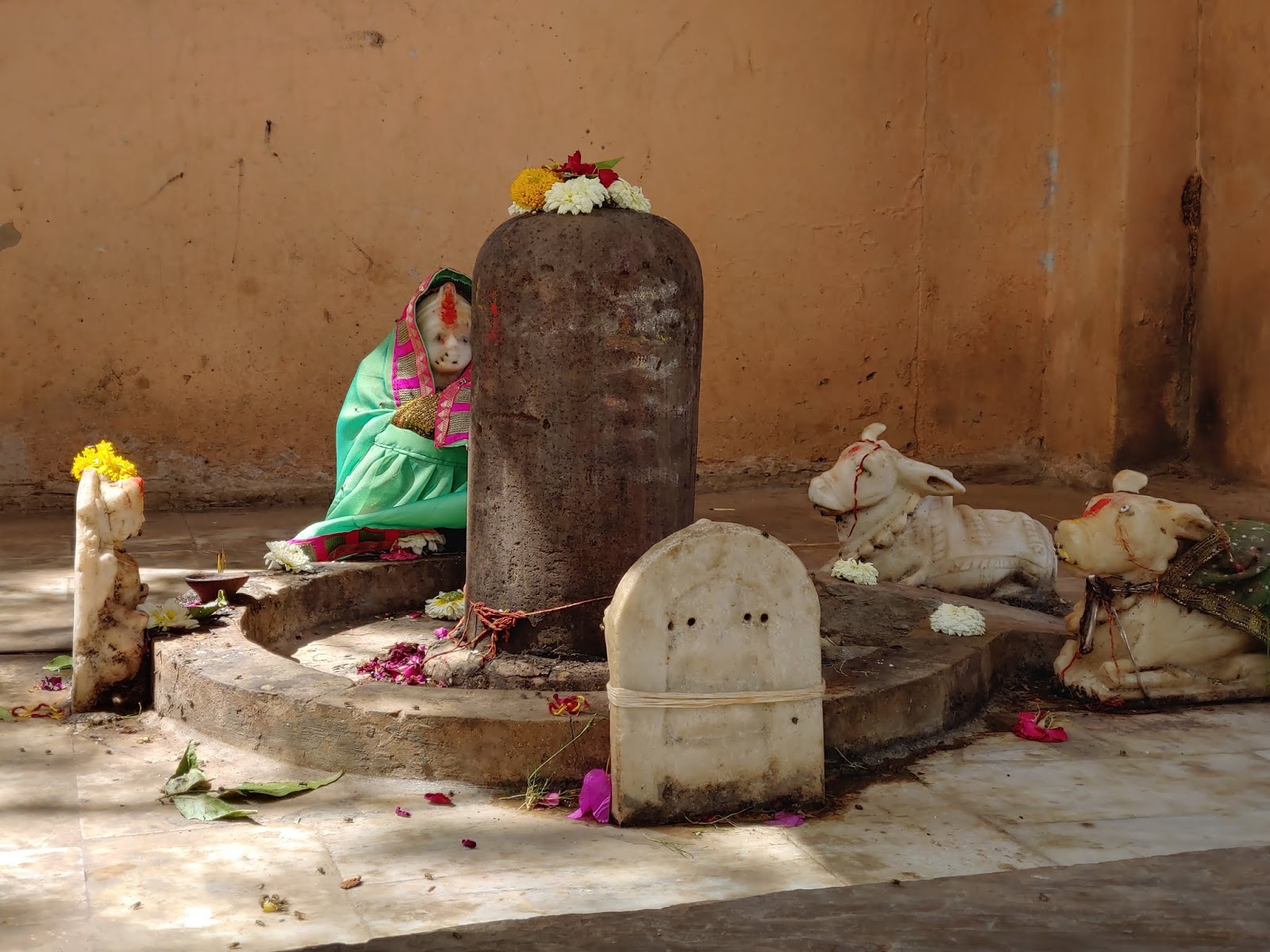
One of the many shrines around Pushkar Lake, this one featuring a lingam. Women hoping to get pregnant tosses flowers onto the top of the very phallic lingam.

As we know, it always comes back to Hanuman and the Ramayana.

Another Hanuman themed shrine.

And another of the hundred shrines that surround the lake.

And another lingam at a small shrine.

The view as you enter the lake.


What It Means - Day 121

"And from the fruits of the date palm and the vine, from which you derive strong drink and goodly provision. Surely in this is a sign for a people who understand." Quran 16:67

"They ask thee about wine and gambling. Say, 'In them there is great sin and [some] benefits for mankind, but their sin is greater than their benefit.'" Quran 2:219

"O you who believe! Draw not near unto prayer when you are drunken until you know what you are uttering, nor in a state of ritual impurity - unless you are passing through - until you have washed." Quran 4:43

"O you who believe! Wine, and gambling, and idols, and divining arrows are but a means of defilement, of Satan's doing. So avoid it, that haply you may prosper. Satan desires only to sow enmity and hatred among you through wine and gambling, and to turn you away from the remembrance of God, and from prayer. Will you, then, refrain." (Quran 5:90-91)

Years ago when I taught in Abu Dhabi I can remember once talking to my female students before class (the classes were always divided by gender, as was the campus, and I only had the opportunity to teach the women). I'm not exactly sure what originated the discussion, but I think it was whether or not I had watched a particular soccer match the night before. The conversation went something like this:

GS: "Yeah, I saw some of it on the TV at the bar while I was waiting to be seated at the restaurant.  The Emirati  guys at the bar were pretty excited."

[Uncomfortable silence]

Student: "Sir (they were painfully polite and always said Sir), they couldn't have been Emiratis."

GS: "I thought they were, but maybe they weren't. The wasn't really the point of the story. Anyway, . . ."

Student: "Sir, I mean, if they were Emiratis then they would be Muslims, and if they were Muslims then they wouldn't be at the bar, so whoever you saw at the bar couldn't have been an Emirati."

GS: [smiling] "I wish you had shown me that much logic on your last essay. [Students laughed] Yeah, I bet they weren't Emiratis. OK, now about today's dis . . ."

Student: [smiling as she comes out with very knowing response] "Yeah, they must have been Saudis." [general laughter, as we all waltzed back from the abyss].

One of the popular perceptions about Islam is that Muslims don't drink. Does this mean that no Muslim ever drinks? Of course not. Muslims, like adherents of every religion in the world, are humans, and humans, as we know, are seldom on task. Which I think is the beauty of that conversation. Some of the more sheltered students were more than a bit shocked that a Muslim would have been drinking, but others, including the young woman who spoke, knew that it wasn't that simple and thus she was taking the opportunity to wind me up a bit in front of her classmates (including the beautiful fail-safe dig at the neighboring Saudis).

Now, since everyone knows that Muslims don't drink this must mean that this is a constant theme throughout the Quran. Actually, no. Wine is only mentioned four times in the Quran, which are the four passages that I cited above. As we know the Quran is not structured chronologically, but there is a fairly general sense of what order the surahs were revealed (although try finding an online list of exactly what year every surah was revealed). The 96th surah (in the order inside the Quran) was actually the first revealed, in 610, whereas the 110th (in the order inside the Quran) was the last revealed (or the 114th in order of revelation), in the year before the Prophet's death.  About three-quarters of the surahs were revealed in Mecca, while the last quarter were revealed later during the time in Medina. Like I said, there's a pretty good sense of where and generally when they were revealed, but the ones around the time when the Prophet finally moved from Mecca to Medina are a little bit more likely to inspire some limited debate.

In regards to the four referenced above:

surah 16 - al-Nahl ("The Bee") - revealed in Mecca, the 70th in order of revelation

surah 2 - al-Baqarah ("The Cow") - revealed in Medina, the 87th in order of revelation

surah 4 - al-Nisa ("Women") - revealed in Medina, the 92nd in order of revelation

surah 5 - al-Ma'idah ("The Table Spread") - revealed in Medina, the 112th in order of revelation

It's not as simple as this, but for our present purpose it's enough.

Essentially, what you have is a progression of the view of wine, but you have to know the order of revelation as compared to the order that you'd find if you just started reading the Quran at surah 1 and then went all the way through to surah 114. But, again, without context how would you possibly know that? Again, this brings us back to having something like Nasr's Study Quran in your possession before you just blindly jump into reading the Quran (it's not that you won't pick up a lot of the beauty and the more complex passages, but there are worlds within worlds here). We've talked before about abrogation, wherein a passage in the Quran will abrogate or replace an earlier passage. As I've said, I have issues with abrogation for any number of reasons, which I will not bore you, again. Going back to the notion of a progression: 1) in surah 16 we're told that God provided many blessings to humankind, including some fruit that can be used to make wine; 2) in surah 2 we're told that wine, like other things, has some benefits but probably more detriments, and so if you drink you need to do so in a moderate, controlled fashion; 3) in surah 4 we're told that you should never pray while intoxicated; and finally 4) in surah 5 we're told that wine is a "defilement" and we shouldn't drink (to be fair, some of the translations of this passage are harsher and more definitive than Nasr's). Let me throw in a couple different translations because I think it's important to get a sense of this key passage (at least in regards to the question of wine):

Yahiya Emerick's translation: "All you who believe! Truly, liquor and gtambling, stone altars (dedicated to 'feeding' idolts) and (using marked) arrowheads (drawn randomly from a bag to apportion meat) are all the disgraceful works of Satan, so forsake them that you may be successful! Satan wants to stir up hostility and hatred among you with liquor and gambling, so as to hinder you from remembering God and (and also to hinder you) from prayer. Won't you give up (those bad habits)?"

Abdyllah Yusuf Ali's translation: "O ye who believe! Intoxicants and gambling, (dedication of) stones, and (divination by) arrows, are an abomination - of Satan's handiwork; eschew such (abomination), that ye may prosper. Satan's plan is (but) to excite enmity and hatred between you, with intoxicants and gambling, and hinder you from the remembrance of Allah, and from prayer: will ye not then abstain?"

To me, all of them are more of a cautionary tale. We aren't told that we will be thrown into the pits of hell, but rather that drinking (and gambling) are bad because they can cause enmity/hatred/hostility between people. The adhadith (the sayings of the Prophet) are more categorical in their rejection of drinking, although even here I don't think there is a record of the Prophet punishing someone for drinking. My collected adhadith are at school, so maybe I'll revisit this question in the future.

So, going back to the abrogation concept,even though three of the four references to wine in the Quran or either positive or at worst cautionary, what matters is that that that last reference to wine, the one in surah 5, which admonishes Muslims to not drink, is the one that matters because it abrogated the other three.  And again, if you don't know the context, in this case the order based on revelation, the final reference you'd come by just reading the Quran "in order," would be one telling you of the blessing of God's gift that led to the creation of wine.

Let me bring in a little corresponding commentary from Nasr from the Study Quran to provide even more context.

First, in regards to surah 2, Nasr explains, "Regarding the benefits for mankind in wine; al-Qurtubi mentions that it helps with digestion, makes a miserly person magnanimous, gives boldness to the timid, gives color to the face, helps one to have sex, and makes one feel good for a short time. (Although this verse mentions specifically wine, Islamic Law understands this ruling to apply to all alcoholic drinks.) . . . As for their harm, intoxication leads to loss of one's rational faculties, quarreling, violence, promiscuity, impaired judgment, and forgetting the remembrance of God." (p. 95)

Again, Nasr, "Although only this last verse amounts to an absolute prohibition against the consumption of alcoholic drink, Islamic jurisprudence, basing itself upon Prophetic sayings (ahadith) and practices (Sunnah), has consistently viewed this last revealed verse as the authoritative one that abrogates the legal implications of the other three." (p. 212)

At this point I suppose the question to ask would be: do I drink? It's my blog and I try to be honest, and I didn't start this reflection on personal faith to pose as something I'm not, so, to be honest, yes, I do have an occasional drink. And I do mean occasional, as in about two beers a month. I drink so little that when I go to the doctor he always records that I don't drink, to which I usually reply, "Oh, I drink, my friend, I mean, not this month, or the last, but, oh, you just watch me next month." It would be the easiest thing in the world for me to not drink those two beers for my faith (I mean, if I can fast during Ramadan I think I could survive without my requisite occasional Switchback). So, why don't I just officially give up drinking for my religion? That's a tougher question. Certainly some of it relates to my own innate contrariness and aversion to authority, which, as I've pointed out in the past, is one of the things that drew me to Islam in the first place; we don't really accept much authority above our own personal relationship with God.  And doubtless some of this relates to my own well-documented struggle between the external and internal aspects of faith; in this case, when we focus on the rules do we sometimes lose our ability to see the reason for the rules. Am I afraid that I'm going to insult God by drinking something whose creation he made possible?  I mean, what's the point of the admonition? My reading of it is that by drinking irresponsibly and to excess we lose sight of our responsibilities, both to our family, friends and society as well as to God (and, again, I think we worship God, in this case remember God, by being a good person and focusing on those responsibilities to family, friends and society). Of course, I could also simply be giving myself an easy pass on this issue, but in the end I don't think my two beers a month are going to doom me to eternal damnation or even qualify me as a bad Muslim or even prove definitively that I'm not actually a Muslim. The vast majority of Muslims, having said all that, don't drink, and I admire their strength and dedication.


Tuesday, July 16, 2019

What It Means - Day 120

"Is one who knows that what has been sent down unto thee from thy Lord is the truth like one who is blind? Only those who possess intellect reflect, who fulfill the pact with God and break not the covenant, who join what God has commanded be joined, fear their Lord, and dread an evil reckoning, and who are patient, seeking the Face of their Lord, perform the prayer, and spend from that which We have provided them, secretly and openly, and who repel evil with good."
Quran 13:19-22

As should be obvious by now, I am always drawn to sections within the Quran which form clearly drawn out guidelines for behavior (I know, I know, my fellow Muslims would no doubt point out that the entire Quran is a guideline for behavior); and I think this is especially true when the instructions convey both the ethereal and more tangible aspects of faith (both are essential, right?).  These passages, drawn from surah number thirteen, usually rendered as "The Thunder," clearly fill that bill.

It starts off with a discussion about the differences between those who know and those who don't know, using a metaphor repeated several times throughout the Quran of those who can see and those who can't. It then goes a list consisting of the more ethereal (performing the prayer, seeking the Face of their Lord, not breaking the covenant) and the more worldly (being patient, spend from that which has been provided, repelling evil with good). In a few short passages a code of conduct is presented. In addition, I'm drawn to the line, "Only those who possess intellect reflect." In the Quran we are never instructed to mindlessly memorize stuff. Rather, we are told to think and reflect. If we're not constantly thinking, and I would argue questioning, our faith then what does it even mean? I'm thinking about this because it relates to one of the great mysteries plaguing the US today: the slavish devotion of the Evangelicals to Donald Trump, the most morally abhorrent person to ever hold the presidency. This is not entirely a trashing of the Evangelicals because all religions, including my own, are dumb in their own way. However, that said, seriously, Evangelicals, what is your deal with Trump? We're the ones in the popular imagination who act unquestioningly, although you only have to pick up any Quran that includes extensive commentary and you quickly get a sense of the theological debate inherent in the faith. And you certainly have that same debate, often over the same questions, inside of Judaism and Catholicism. When Luther dropped good works out of the traditional Catholic balancing act between faith and good works did he, unintentionally, set the stage for this age's uncritical blind faith? Debate and questioning are certainly a part of many branches of mainstream Protestantism, but it seems to have disappeared, at least temporarily, with the Evangelicals.  There seems to be an utter rejection of the role of reason, or what we would call in Islam kalam, that would make a Wahabi proud.


Monday, July 15, 2019

What It Means - Day 119

"That is because God never changes a blessing by which He blesses a people until they change what is in themselves and because God is Hearing, Knowing."
Quran 8:53

Here is a brief passage that is drawn from the 8th surah, which is usually rendered as "The Spoils." Sometimes when I'm rereading a section and I see that I marked it on an earlier reading I momentarily wonder why - and obviously it works both ways, because sometimes I look at a section which exists in its pristine form and I'm amazed because it's amazing. This falls into neither for the former nor the latter category because I loved it the first time I read it and have every time since.

As part of his commentary Nasr tells us, "In its most general sense, God never changes a blessing by which He blesses a people until they change what is in themselves means that God gives human beings intelligence, strength, free will, and good things in life, so that they can worship God and do good, but when they turn away from these blessings in favor of sin and lack of faith, they have changed what is in themselves." (Study Quran, p. 496)

As I've proposed previously, in many ways I think that the concepts to "worship God and do good" are actually the same thing. That is, we are given the opportunity, and the tools, to do good, and in the process of doing good we are worshiping God. Or, to put it another way, if you want to worship God then do good things, because, at least in my mind, God is not so lonely or insecure that He needs our attention. Having said that, of the two options I find the former more beautiful than the latter, simply because we should do good things because that is what humans should do, not because I want to be paid off in the end with some sort of divine prize.

In addition, what speaks to me about this passage is that it addresses a measure of human agency. Even if God is immeasurably powerful and all-knowing, in the end we are not merely motes floating in the cosmic breeze. If humans don't have the power to "change what is in themselves" then what is the point of faith?