Sunday, September 11, 2016

My Year With Proust - Day 252

   I should have liked, before kissing her, to be able to breathe into her anew the mystery which had had for me on the beach before I knew her, to discover in her the place where she had lived earlier; in its stead at least, if I knew nothing of it, I could insinuate all the memories of our life at Balbec, the sound of the waves breaking beneath my window, the shouts of the children.  But when I let my eyes glide over the charming pink globe of her cheeks, the gently curving surfaces of which expired beneath the first foothills of her beautiful black hair which ran in undulating ridges, thrust out its escarpments, and moulded the hollows and ripples of its valleys, I could not help saying to myself" "Now at last, after failing at Balbec, I am going to discover the fragrance of the secret rose that blooms in Albertine's cheeks.  And, since, the cycle through which we are able to make things and people pass in the course of our existence are comparatively few, perhaps I shall be able to consider mine in a certain sense fulfilled when, having taken out of its distant frame the blossoming face that I had chosen from among all others, I shall have brought it onto this new plane, where I shall at last have knowledge of it through my lips." I told myself this because I believed that there was such a thing as knowledge acquired by the lips; I told myself that I was going to know the taste of this fleshly rose, because I had not stopped to think that man, a creature obviously less rudimentary than the sea-urchin or even the whale, nevertheless lacks a certain number of essential organs, and notably possesses none that will serve for kissing.  For this absent organ he substitutes his lips, and thereby arrives perhaps at a slightly more satisfying result than if he were reduced to caressing the beloved with a horny tusk.  But a pair of lips, designed to convey to the palate the taste of whatever whets his appetite, must be content, without understanding their mistake or admitting their disappointment, with roaming over the surface and with coming to a halt at the barrier of the impenetrable and irresistible cheek.  Moreover at that moment of actual contact with the flesh, the lips, even on the assumption that they might become more expert and better endowed, would doubtless be unable to enjoy any more fully the savour which nature prevents their ever actually grasping, for in that desolate zone in which they are unable to find their proper nourishment they are alone, the sense of sight, then that of smell, having long since deserted them.  At first, as my mouth began gradually to approach the cheeks which my eyes had recommended it to kiss, my eyes, in changing position, saw a different pair of cheeks; the neck, observed at closer ranged and as though through a magnifying glass, showed in its coarser grain a robustness which modified the character of the face.
Marcel Proust, The Guermantes Way, pp. 377-378

Things continue to get more and more serious, or at least more and more physical, between Marcel and Albertine.  Several things jump out at me in this passage, one of them being that despite Proust's usual sensitivity he unconsciously, or maybe quite consciously, portrayed the encounter as a military campaign.  He reflects on how "after failing at Balbec" he was going to discover more this time.  Even the description of Albertine's body reads like a map of desirable terrain: "But when I let my eyes glide over the charming pink globe of her cheeks, the gently curving surfaces of which expired beneath the first foothills of her beautiful black hair which ran in undulating ridges, thrust out its escarpments, and moulded the hollows and ripples of its valleys . . ."  So, for Marcel, like the rest of us, is sex just a matter of conquest?  A physical conquest?  Potentially; although I'm not that convinced that it is only sexual or physical.  Taken in the broader arc of their time together I think it relates to his reconquest of memory.  He tells us, "I should have liked, before kissing her, to be able to breathe into her anew the mystery which had had for me on the beach before I knew her, to discover in her the place where she had lived earlier; in its stead at least, if I knew nothing of it, I could insinuate all the memories of our life at Balbec, the sound of the waves breaking beneath my window, the shouts of the children."  Is this why we end up feeling so consumingly sad when we've slipped up and had sex with an ex; not because we've cheated on our present girlfriend, but because we've once again failed to recapture the past?

Proust's discussion of his lips, and their limitation, is also interesting.  Proust proposes, "For this absent organ he substitutes his lips, and thereby arrives perhaps at a slightly more satisfying result than if he were reduced to caressing the beloved with a horny tusk.  But a pair of lips, designed to convey to the palate the taste of whatever whets his appetite, must be content, without understanding their mistake or admitting their disappointment, with roaming over the surface and with coming to a halt at the barrier of the impenetrable and irresistible cheek." As I'm sure I've mentioned previously, the ancient Chinese philosophers grappled with the role of the sense organs because they are magnetically drawn to beauty - which is why Mencius proposed just being guided by the heart (mind). Proust tells us, ". . . my mouth began gradually to approach the cheeks which my eyes had recommended it to kiss . . ." As we know, the brain (and for that matter evolution) has its own agenda, and there logically, and thus illogically, must be a reason why the lips and the eyes are leading us in a certain direction.  But in following the demands of sensation - and the mad dance of evolutionary need - what else are we missing?

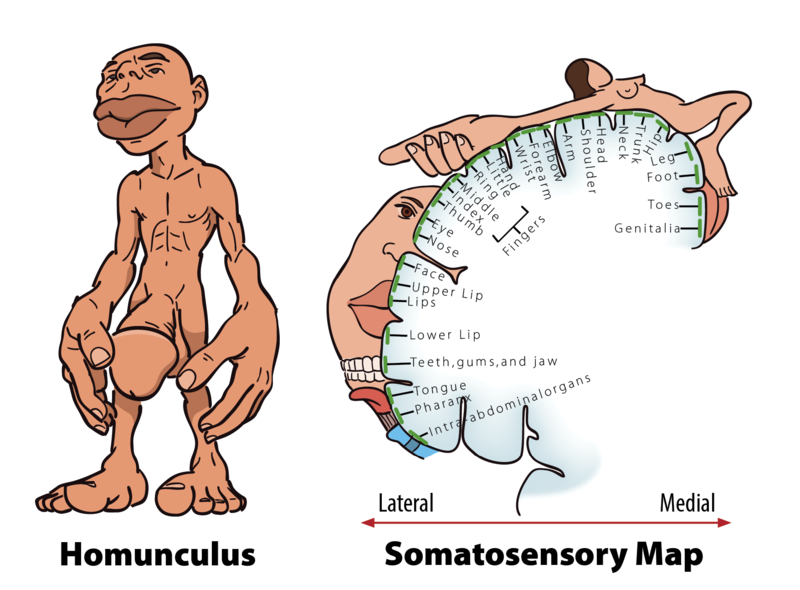
An diagram, complete with homunculus, showing the relative sensitivity of various sense organs, which, reflecting on the Proust passage above, represents the important role of the lips.  I've seen different versions of this homunculus, including one that appears in Linden's The Accidental Mind.  I borrowed this one from Adam John Privitera from Chemeketa Community College (http://nobaproject.com/modules/sensation-and-perception).

Saturday, September 10, 2016

Discography - Week 21

We've moved on to the twenty-first week of our weekly Discography discussion.  I like all the selections this week, and I suspect that more will sneak in before the weekend plays itself out.  This week we're featuring our first Trigger Warning, although I suspect not our last. Trigger Warnings are designed to warn a fellow Discography member (could be anyone, really) not to read further because it would be an affront to everything they hold dear musically. This is not the same as the person mentioned being labelled a Walking Trigger Warning (although she is, although this could be anyone).  That would be a good theme week: Trigger Warning Songs for a specific Discography member (could be anyone).


Nate Bell

I'm pretty excited about this pick, and I hope I can convince the group to listen to this whole album, just so we can discuss it.

Kentucky Knife Fight, Bad Blood and Father from Hush, Hush

About 5-6 years ago, M and I were attending the local Midpoint Music Festival, and stumbled across this band.  At the time, they were in one of the worst venues, in a decent bar, but with the band set up in a server's station next to a stairwell.  We immediately latched onto their incredibly diverse and unique sound.  There was a starveling bald lead singer, strong guitar and bass, and harmonica and banjo.  Their sound eludes categorization, but the closest I can come is "post-punk noir rock".

The sound was insistent and harsh...the singers voice is at once reedy, buzzing and a growl, unlike almost anything else I had heard.  We rushed to buy a CD.

The band is Kentucky Knife Fight, and despite the name, they are not alt-country, no one is from Kentucky, and there is no mention of knife fighting or even a knife that I can recall in any of their albums.  This band has since broken up, but they are from St. Louis, and had a very strong following there.  M and I traveled to see them a handful of times after that first concert, and ended up spending a fair amount of time talking to the various band members about politics, the state of education in America, disabilities, urbanization, crime, racism, and literature.  And they play some great music.

The front man, a wasted and tortured soul, was clearly the inspirational force behind the band, and it is clear that he is, at heart, a writer with a music problem.  The selections I have for you this week come from Hush Hush.  This album is a "concept album", but I feel it goes beyond that often-worn description, and it is actually a well-crafted short story with music.  The album tells a tale of a awful and sordid crime, a diamond heist gone terribly wrong, told from the varying points of view of the couple enlisted to commit the crime, and their sociopathic, petty mastermind of a "recruiter".  It is told also in flashbacks, backstory, and retrospective, all glimpses of characters and history that is fascinating--facets, if you will of an entire whole.  The band describes the album as :  A seductive collection of songs about crime and human sexuality, which attempts to understand why good people do bad things.

I was very compelled by the vocal style, but others may be immediately put off by it.  I would encourage you to power through the vocal style if you do not enjoy it, and listen to the lyrics and phrasing, and I think you will be intrigued by the storyline.  

"Bad Blood"--this song is energetic, pounding, and chaotic.  It's told from the point of view of one of the newly recruited criminals, and it captures very well an emotive sense of the greasy, amphetamine driven rush of the criminal's excitement at the prospect of the caper, and the lyrics hint at the harsh resolution that is to come.  You can clearly see the dodgy interior of the Tic Toc Inn and the sketchy, twitchy motions of the newly recruited thug.

This piece is told from the point of view of the Recruiter, who is simultaneous recruiting one of the people who will commit the deed, while at the same time reminiscing in glee about a major crime the Recruiter committed with the subject's father in the distant past.  The old and storied crime appears to be the sort of chaos and destruction done without any apparent purpose other than to sow strife.  It is told musically in a languid, tingling, but sinister form, building to a crescendo that reveals the deep seated psychopathy of the Recruiter---showing the listener where the current plot will lead, to the destruction of the flawed and tainted ne'er do wells who will carry out the heist and murder.  Even in the memory of the Recruiter, the past Grand Crime resulted in a nearly deadly confrontation which the Recruiter appears to recall with great fondness and pride, which in itself is enough to cause a small shiver in the spine of the listener.  (the youtube video is not, unfortunately, as good as the album version or the live versions we heard, but was the best one I could find)  Here are the lyrics, from their still operative website.


I truly encourage the group to listen to the whole album as a whole story.  We will gladly share the album, so that we can all discuss the "story" contained in it.  I hope you find it as darkly interesting as we do.


Miranda Tavares


Cake has a unique sound, but it is a specific sound, sometimes stopping just short of formulaic, and this song is no exception. So why pick it? Well, the timing is pretty cool, even by Cake standards. And the patented Cake awkwardness is minimized, which I prefer (except in Sad Songs and Waltzes, which is kind of the point of the song). But mostly, this is a man singing about wanting a strong woman. It is a song about a woman who is a force to be reckoned with. This chick is freaking amazing. She is a worthy role model for all women. Fellow females (of which there is exactly one on this blog - Gary B., can you PLEASE convince Marjie to join in now and then) let's don our short skirts and long jackets and forego the sexist pantyhose. I will aim for having a mind like a diamond; I have always wanted to be fast, and thorough, and sharp as a tack; I would love to wield a machete to cut through red tape; and who doesn't want fingernails that shine like justice?! But...this song is a dude's list about his requirements. It is a shopping list for a woman. Essentially, he is creating his own version of a Stepford wife...who just happens to be powerful instead of yielding. Does the latter cancel out the former? Does it make it all politically correct? I am not entirely sure. But I do know that, right or wrong, I still want to be that girl. 


Dave Wallace

Tommy James and the Shondells, Mony Mony


Party Time!!  One of the all-time great rock songs, with the catchy keyboard riff, the brilliant call-and-response, the delirious "Mony Mony" chant, and the fantastic break.  Then, just when you think it can't go any higher, the song finds another gear towards the end, with James yelling "Come ON!" repeatedly.  Irresistible!


Gary Beatrice

Wilco, At Least That’s What You Said

Cyndi and I have something in common. I am a Wilco boy. And I've got it bad.

I may have lost some alt.country cred last week when I argued that the Bottle Rockets are at least as good as Uncle Tupelo. Well Gary may kick me off the blog today.

Jeff Tweedy and Wilco have far exceeded the music of Sun Volt and Jay Farrer in his numerous post Uncle Tupelo incarnations. And, in fact, alt.country or not, Wilco's music is better than Uncle Tupelo's. Maybe not more important, certainly not more influential. But better.

I've read the lyrics to At Least That's What You Said, and the best I can tell they don't mean a thing. And that is fine by me. This is all about a great band stretching out and sounding outstanding. Like Cyndi, this is one of many Wilco songs that never fails to put me in a good mood.


Dave Kelley

Here comes the inevitable overwrought DK post about Bruce Springsteen.  Once again, I am going to cheat a bit and include two songs.  I think this is legitimate though because the songs are linked, and the second one even references the first.  To me they represent the yin and yang of The Boss.

The first is Thunder Road.  Need I even say much about this classic?  Any song that begins "The screen door slams, Mary's dress waives, like a vision she dances across the porch as the radio plays", includes such great singing and piano work, and concludes with:

"There were ghosts in the eyes of all the boys you sent away.  They haunt this dusty beach road in the skeleton frames of burned out Chevrolets.  They scream your name at night in the streets, your graduation gown lies in rags at their feet.  And in the lonely cool before dawn, you hear their engines roaring on.  But when you get to the porch they're gone, On the wind.  So Mary climb in.  It's a town full of losers, and I am pulling out of here to win." is a classic.  To my ear, it is the most perfect song of the rock era.  I would not change a damn thing.

Bruce wrote this in his early twenties.  That is a time in many of our lives when we are Romantics in every sense of the term.  The perfect night with the right girl, the right car, and the right opportunity makes everything possible.  All things are within our grasp.  Bruce has described the a great pop single as the eternal now.  I think "Thunder Road" captures that feeling   I think the spirit that infuses "Thunder Road" should still grab us occasionally no matter our age.

But life is not that simple.  Life is messier than art.  The perfect night with the perfect girl ends, and the new day must be faced.  Most of our dreams are not totally fullfilled.  Fuck, most of them are not fulfilled at all.  A young person's dreams become an adult's regrets more often than not.  "Is a dream a lie if it don't come true, or is it something worse."  Life is not art.  It is not perfection.  It is more often than not a series of compromises and disappointments.  I think a huge part of adulthood is dealing with these hard realities without waving a white flag. 

After the great success of the Born to Run record and tour, Bruce realized that he had signed an awful deal with his producer.  To make matters worse, his producer was a dear friend and someone that Bruce felt he could trust.  Mike Appel not only owned Bruce's music, he controlled his future releases and was able to get an injunction which prevented Springsteen from recording with anyone else.  For several years, Bruce could not release new music and had to support himself and the band by playing live.  His cover of "It's My Life" in his live shows  of that period reflect his feelings and his anger.  Eventually he regained control of his music and his future by signing a big check.  This left him deeply in debt but back in control.  He said that more than money, more than fame, and even more than happiness, he wanted to be great.

I think "Darkness on the Edge of Town" is perhaps Bruce's greatest record.  It is very much informed by the betrayal he felt from a dear friend.  Bruce gave many great songs that he wrote at the time away to other artists because he felt that they did not fit with the "apocolyptic grandeur" that he was seeking.  "Fire" and "Because the Night" are two of the songs he gave to others.  However, there was another song left off of the record that he did not give away.  To my mind, it is one of the five or ten best song he has ever written.  It would have fit perfectly on Darkness but perhaps it hit too close to home.  That song is "The Promise", and it is my second selection for the week.

The singer in "The Promise" is not a musician but is instead a guy who built a race car.  A Challenger.  The song is about betrayal and cashing in on a dream. The romanticism of "Thunder Road" has been replaced with the realism and hard realities of adulthood.

"Well I built that Challenger by myself
But I needed money
and so I sold it
I lived a secret I should have kept to myself
but I got drunk one night and I told it.

All my life I fought that fight
that fight no man can ever win
every day it just gets harder to live
that dream you're believing in"

Later he sings:

"When the promise is broken
you go on living
but it steals something from down in your soul
Like when the truth is spoken
but it don't make no difference
and something in your heart goes cold."

At several points in the song, the singer plaintively repeats the line "Thunder Road" making the connection between the two songs clear. 

"Thunder Road is for the lost lovers and all the fixed games
Thunder Road is for the tires rushing by in the rain
Thunder Road, me and Billy we'd always sing
Thunder Road, we'd take it all and throw it all away."


For me, The Promise is about holding onto your ideals after you have lost your idealism.  It is about living a life filled with compromises and disappointments and yet not giving up.  You and Mary may may have pulled out of there to win, but hard reality ultimtely sets in and what the fuck are you going to do about that.   A much more recent Bruce song talks about "Hold tight to your anger, but don't fall to your fears."   I have a hard time listening to "The Promise" without getting teary eyed. 


Gary Scudder

* * * MIRANDA TRIGGER WARNING * * *

Frank Sinatra, If You Are But a Dream

I had a couple different songs that I was considering this week, but in the end I just followed my usual dictate of just writing up what I'm listening to that week.  Recently I downloaded the Essential Frank Sinatra from the Columbia Years (which I owned as a CD in a different lifetime).  Yes, I admit it, I love Frank Sinatra.  The most excellent Gary Beatrice and I have had a long-running, although friendly, debate on which Sinatra is better: the Big Band Frank from the 1940s or the Cool Frank from the 1950s and early 1960s?  They are both noble options, but I tend to come down on the side of Big Band Frank.  To me this is just about a perfect song.   It also provided the soundtrack for one of the great movie scenes of all-time: Woody Allen reflecting upon his first visit to Radio City Music Hall from the sadly underappreciated film, Radio Days.

My Year With Proust - Day 251

   What a difference there is between possessing a woman to whom one applies one's body alone, because she is no more than a piece of flesh, and possessing the girl whom one used to see on the beach with her friends on certain days without even knowing why one saw her on those days and not on others, so that one trembled at the thought that one might not see her again!  Life had obligingly revealed to one in its whole extent the novel of this little girl's life, had lent one, for the study of her, first one optical instrument, then another, and had added to carnal desire the accompaniment, which multiplies and diversifies it, of those other desires, more spiritual and less easily assuaged, which do not emerge from their torpor but leave it to carry on alone when it aims only at the conquest of a piece of flesh, but which, to gain possession of a whole tract of memories from which they have felt nostalgically exiled, come surging round it, enlarge and extend it, are unable to follow it to the fulfillment, to the assimilation, impossible in the form in which it is looked for, of an immaterial reality, but wait for this desire half-way and at the moment of return, provide it once more with their escort; to kiss, instead of the cheeks of the first comer, anonymous, without mystery or glamour, however cool and fresh they may be, those of which I had so long been dreaming, would be to know the taste, the savour, of a colour on which I had endlessly gazed. One has seen a woman, a mere image in the decorative setting of life, like Albertine silhouetted against the sea, and then one has been able to take that image, to detach it, to bring it also to oneself, gradually to discern its volume, its colours, as though one had placed it behind the lens of a stereoscope.  It is for this reason that women who are to some extent resistant, whom one cannot possess at once, of whom one dos not indeed know at first whether one will ever possess them, are alone interesting.  For to know them, to approach the, to conquer them is to make the human image vary in shape, in dimension, in relief, is a lesson in relativity in the appreciation of a woman's body, a woman's life, so delightful to see afresh when it has resumed the slender proportions of a silhouette against the back-drop of life.  The women one meets first of all in in a brothel are of no interest because they remain invariable.
Marcel Proust, The Guermantes Way, pp. 375-376

This is quickly becoming one of my favorite passages.  Marcel continues to get closer to Albertine, both physically and, although he seems to be dismiss of the fact, emotionally, after assuming that she was gone for ever.  A couple days ago I was talking about the clumsy courting techniques of Marcel, an allegedly experienced (albeit relatively so) man of the world.  My theory was that he was resorting to "tricking" her into tickling him, and thus touching him, because he was not in fact no longer in love with her, but exactly the opposite.  When we love someone we transition back to middle school emotionally, which displays itself in a stunted level of maturity.

What makes this more complicated is that his attachment to Albertine is not simply based on love, but has become almost a metaphor of his entire quest to regain time.  As life lays out the :whole extent the novel of this little girl's life" it is also handing the past back to Marcel.  So, it's not simply Albertine who is returning to him, but the entire life that she played a role, for which she acted as a silhouette.  This means that it is not simply "the conquest of a piece of flesh."  Rather, because you know and love the person it allows you "to gain possession of a whole tract of memories from which they have felt nostalgically exile" and thus the memories "come surging round it, enlarge and extend it"

And this is why, according to Proust, this experience is so much more powerful and profound than simply visiting a brothel, or, for that matter, in sleeping with any casual acquaintance.  It's not necessarily something as trite as love vs lust, but rather the potential to regain memory or to view life more fully.  "For to know them, to approach the, to conquer them is to make the human image vary in shape, in dimension, in relief, is a lesson in relativity in the appreciation of a woman's body, a woman's life, so delightful to see afresh when it has resumed the slender proportions of a silhouette against the back-drop of life."

Friday, September 9, 2016

My Year With Proust - Day 250

. . . My surplus of knowledge of life (life as being less uniform, less simple than I had at first supposed it to be) inclined me provisionally towards agnosticism.  What can one positively affirm, when the thing that one thought probable at first has then shown itself to be false and in the third instance turns out true?  (And alas, I was not yet at the end of my discoveries with regard to Albertine).
Marcel Proust, The Guermantes Way, p. 375

Although I often find a tremendous sense of affinity with Marcel, I don't normally put myself in his place.  So, when he's philosophizing about the folly of lingering before the hawthorns I completely understand it - at least the quest, if not the answer.  If Proust is struggling with essential questions of beauty then by definition I'm doomed.  I don't often see myself in his (or Swann's) hopeless moping around over various and sundry women.  Rather, like all people who self-delusional souls who ignore the log in their own eyes while commenting on the specks in others, I pity my friends for somehow finding their way into Remembrance of Things Past.  However, in this case I'm clearly Marcel because I had/have my own perplexing long-term relationship, which was probable and then false and then true and will in the end doubtless stall out at probable.  I find it interesting that he said that the experience inclined him "provisionally towards agnosticism."  It led me to ask myself when I first realized that life was not certain or guaranteed?  And when I therefore became an emotional/intellectual atheist (believing that there was no meaning or purpose to love) - and when did I become certain that it is true (or will I ever realize it)?  I don't have the answer to these questions yet, but I am officially on the clock.


My Year With Proust - Day 249

   When Francoise had left the room and Albertine was seated once again on my bed:
   "Do you know what I'm afraid of?"  I asked her.  "It is that if we go on like this I may not be able to resist the temptation to kiss you."
   "That would be a happy misfortune."
   I did not respond at once to this invitation.  Another man might even have found it superfluous, for Albertine's way of pronouncing her words was so carnal, so seductive that merely in speaking to you she seemed to be caressing you.  A word from her was a favour, and her conversation covered you with kisses.  And yet it was highly gratifying to me, this invitation.  If would have been ok, indeed, coming from any pretty girl of Albertine's age; but that Albertine should be now so accessible to me gave me more than pleasure, brought before my eyes a series of images fraught with beauty.  I remembered Albertine first of all on the beach, almost painted upon a background of sea, having for me no more real an existence than those theatrical tableaux in which one does not know whether one is looking at the actress herself who is supposed to appear, at an understudy who for the moment is taking her principal's part, or simply a projection.  Then the real woman had detached herself from the beam of light and had come towards me, but only for me to perceive that in the real world she had none of the amorous facility with which one had credited her in the magic tableau.  I had learned that it was not possible to touch her, to kiss her, that one might only talk to her, that for me she was no more a woman than jade grapes, an inedible decoration at one time in fashion on dinner tables, are really fruit.  And now she was appearing to me on a third plane, real as in the second experience that I had had of her but available as in the first; available, and all the more delicious so in that I had long imagined that she was not.
Marcel Proust, The Guermantes Way, pp. 374-375

Marcel proposes, ". . . if we go on like this I may not be able to resist the temptation to kiss you."  Albertine respondes, "That would be a happy misfortune."  As my excellent friend Mike Kelly would opine, shit is getting real. Or maybe it's not.  It seems like they are still lightly flirting, but there is an earthiness, barely constrained, that is slipping through, although, again, we're still witnessing a lot of posturing.

Proust reflects upon the power of Albertine's words.  "Another man might even have found it superfluous, for Albertine's way of pronouncing her words was so carnal, so seductive that merely in speaking to you she seemed to be caressing you.  A word from her was a favour, and her conversation covered you with kisses."  It's difficult for me to read this passage and not play Lucinda Williams' Something About What Happens When We Talk from her wonderful Sweet Old World album in the background.  The big difference is that Lucinda brings an authenticity based on experience that Albertine clearly hasn't earned.  That said, some women can make the most casual statement into a more erotically charged statement than reams of inauthentic naughtiness from other women.  Clearly, Albertine has "it", not matter how you define "it."

But why?  Doubtless part of this relates, as always seems to be the case in Remembrance of Things Past, of perception and memory.  "If would have been ok, indeed, coming from any pretty girl of Albertine's age; but that Albertine should be now so accessible to me gave me more than pleasure, brought before my eyes a series of images fraught with beauty.  I remembered Albertine first of all on the beach, almost painted upon a background of sea, having for me no more real an existence than those theatrical tableaux in which one does not know whether one is looking at the actress herself who is supposed to appear, at an understudy who for the moment is taking her principal's part, or simply a projection"  Albertine, "almost painted," still exists on that beach in Marcel's mind.


Wednesday, September 7, 2016

My Year With Proust - Day 248

   Not only did I no longer feel any love for her, but I no longer had to consider, as I might have at Balbec, the risk of shattering in her an affection for myself, since it no longer existed.  There could be no doubt that she had long since become quite indifferent to me.  I was well aware that to her I was no longer in any sense a member of the "little band" into which I had at one time so anxiously sought and had then been so happy to have secured admission.  Besides, since she no longer even had, as in the Balbec days, an air of frank good nature, I felt no serious scruples.  However, I think what finally decided me was another philological discovery.  As, continuing to add fresh links to the external chain of talk behind which I had my inner desire, I spoke (having Albertine secure now on the corner of my bed) of one of the girls of the little band who was less striking than the rest but whom nevertheless I had thought quite pretty.  "Yes," answered Albertine, "she reminds me of a little mousme." Clearly, when I first knew Albertine the word was unknown to her.  It was probable that, had things followed their normal course, she would never have learned it, and for my part I should have seen no cause for regret in that, for there is no more repulsive word in the language.  There mere sound of it sets one's teeth on edge as when one has put too large a spoonful of ice in one's mouth.  But coming from Albertine, pretty as she was, not even "mousme" could strike me as unpleasing.  On the contrary, I felt it to be a revelation, if not of an external initiation, at any rate of an internal evolution.  Unfortunately it was now time for me to bid her good-bye if I wished her to reach home in time for her dinner, and myself to be out of bed and dressed in time for my own.  It was Francoise who was preparing it; she did not like it to be delayed, and must already have found it an infringement of one of the articles of her code that Albertine, in the absence of my parents, should be paying ma so prolonged a visit, and one which was going to make everything late.  but before "mouseme" all these arguments fell to the ground and I hasted to say:
   "You know, I'm not in the least ticklish.  You could go on tickling me for a whole hour and I wouldn't feel it."
   "Really?"
   "I assure you."
   She understood, doubtless, that this was the awkward expression of a desire on my part, for, like a person who offers to give you an introduction for which you have not ventured to ask, though what you have said has shown him that it would be of great service to you:
   "Would you like me to try?" she inquired with womanly meekness.
  "Just as you like, but you would be more comfortable if you lay down properly on the bed."
   "Like that?"
   "No, further in."
   "You're sure I'm not too heavy?"
   As she uttered these words the door opened and Francoise walked in carrying a lamp.  Albertine just had time to scramble back on to her chair. . . ."
Marcel Proust, The Guermantes Way, pp. 370-371

An odd, almost childish scene, but what that is steeped in the gender and social rules of the age.  It reads like the attempt of a sophomore boy to get a girl to "touch it" rather than the actions of a sophisticated Frenchman.  Although, that comment speaks to my own sense of a French cultural/social identity, by which I mean that I naturally assume that the French are having a lot of sex all the time and thus wouldn't be so utterly clumsy.  Having said that, maybe the very clumsiness of the scene gives us an insight in how Marcel actually feels about Albertine.  Proust writes, "Not only did I no longer feel any love for her, but I no longer had to consider, as I might have at Balbec, the risk of shattering in her an affection for myself, since it no longer existed," implying that not only does he not love her, but she clearly does not love him anymore either.  Consequently, he assures us, "I felt no serious scruples."  Marcel is certainly portraying himself as an experienced lover, and as everyone knows one of the greatest advantages of growing older is getting past the stage where you are involved in the pantomime where you're "tricking" the other person into having sex with you.  Both of you know exactly why you showed up, but by engaging in this shared performance piece that allows you both, especially her, plausible deniability.  When you're older you're comfortable enough to say to her, "meet me in the back stairwell at 9:30 and where this (some scandalous bit of naughty clothing)" and she's also older and comfortable enough to respond, "no, idiot, I'll meet you in the back stairwell at 10:30 and you wear it."  Now, Marcel by this time is supposed to be experienced and is in the process of trying to set up an assignation with an experienced society lady/courtesan, which I'm assuming will not include a challenge that he can't be tickled.  So, is he playing this game to "protect" her innocence if he claims to not love her anymore - or is he protecting the purity of the innocence of his memory of their love?  It could also be something as simple as the fact that he's still in love with her, and thus the rules of exchange are different than with he's truly just meeting for sex.


Tuesday, September 6, 2016

My Year With Proust - Day 247

. . . There were other more attractive novelties in her; I sensed, in this same pretty girl who had just sat down by my bed, something that was different; and in those lines which, in the look and the features of the face, express a person's habitual volition, a change of front, a partial conversion, as though something had happened to break down those resistances I had come up against in Balbec one long-ego evening when we had formed a couple asymmetrical with but the converse of our present arrangement, for then it had been she who was lying down and I by her bedside.  Wishing and not daring to ascertain whether she would now let herself be kissed, every time that she rose to go I asked her to stay a little longer.  This was a concession not very easy to obtain, for although she had nothing to do (otherwise she would have rushed out of the house) she was a person methodical in her habits and moreover not very gracious towards me, seeming no longer to take pleasure in my company.  Yet each time, after looking at her watch, she sat down again at my request until finally she had spent several hours with me without my having asked her for anything; the things I said to her were connected with those I had said during the preceding hours, and were totally unconnected with what I was thinking about, what I desired from her, remained obstinately parallel thereto.  There is nothing like desire for preventing the things one says from bearing any resemblance to what one has in one's mind.  Time passes, and yet it seems as though we were seeking to gain time by speaking of subjects absolutely alien to the one that preoccupies us. We go on chatting, whereas the sentence we should like to utter would have been accompanied by a gesture, if indeed we have not (to give ourselves the pleasure of immediate action and to gratify the curiosity we feel as to the reactions which will follow it, without saying a word, without a by-your-leave) already made this gesture.  Certainly I was not in the least in love with Albertine; child of the mists outside, she could simply satisfy the fanciful desire which the change of weather had awakened in me and which was midway between the desires that are satisfied by the arts of the kitchens and the monumental sculpture respectively, for it made me dream simultaneously of mingling with my flesh a substance different and warm, and of attaching at some point of my recumbent body a divergent one, as the body of Eve barely holds by the feet to the side of Adam, to whose body hers is almost perpendicular, in those Romanesque bas-reliefs in the church at Balbec which represent in so noble and reposeful a fashion, still almost like a classical frieze, the creation of woman; God in them is everywhere, followed, as by two ministers, by two little angels in whom one recognises - like those winged, swarming summer creatures which winter has caught by surprise and spared - cupids from Herculaneum still surviving well into the thirteenth century, and winging their last slow flight, weary but never failing in the grace that might be expected of them, over the whole front of the porch.
Marcel Proust, The Guermantes Way, pp. 366-367

As we've been discussing Albertine has reappeared in Marcel's life.  One of their last meeting was his disastrous attempt to make love to her the night she stayed in his hotel.  Either she changed her mind or he magnificently misread her signals.  Now, however, things seem to have changed.  "I sensed, in this same pretty girl who had just sat down by my bed, something that was different; and in those lines which, in the look and the features of the face, express a person's habitual volition, a change of front, a partial conversion, as though something had happened to break down those resistances I had come up against in Balbec . . ."  Of course, the change may be in Marcel himself, who now claims that he no longer loves Albertine.  He tells us, "Certainly I was not in the least in love with Albertine; child of the mists outside, she could simply satisfy the fanciful desire which the change of weather had awakened in me . . ."  Rather, he now views her as a vessel for his wanderlust, maybe even more than his lust, caused by the changing season.  Is this seeming disdainful cruelty based on his embarrassment for his earlier folly?  Or does he still love her, but has to pretend, either consciously or unconsciously, that he is over her - so over her that he can just use her - to vouchsafe his maturity and sophistication?  Or does he truly desire her, and, like the rest of us, this shatters the connection between cause and effect: "There is nothing like desire for preventing the things one says from bearing any resemblance to what one has in one's mind."