Showing posts with label Russia. Show all posts

Tuesday, October 3, 2017

Katya

OK, so I shamelessly swiped this picture off of Facebook.  I broke one of my cardinal rules and hopped back on Facebook to set up a private page for the parents of the students heading to Zanzibar in January (and another one soon for the parents of the students heading to Jordan in March).  As soon as I got back on a hundred people Liked it and several asked if I was planning on staying (as in real life, I'm infamous for disappearing from FB).  I said no, but here's my email address if you want to chat.  Facebook annoys me no end and I devote my attention to Twitter and, obviously, to this long-suffering blog.  That said, when I checked in the other day to see if any of the parents had questions I saw this painfully cute picture of my friend Katya, also known by her full name Ekaterina Talalakina, who I met years ago when I ran my international program here at Champlain.  I visited her twice in Moscow, and she led a group of students on a visit to Vermont. 

There are a lot of things that I miss about running my Global Modules program, and, although it may sound hackneyed, it's doubtless friend like Katya I miss the most.


Monday, January 13, 2014

Russian Memories

Just a brief post inspired by my excellent friend Kerry sending along a picture from the time I led a team of Champlain professors to Moscow as part of the now sadly-deceased Global Modules program.  Home visits - and meals - are always the best parts of overseas trips.


Monday, January 30, 2012

Why Me Laugh?


I was cleaning up my files - as with all professors, I'll do anything in place of grading - and came across this bizarre picture from right outside Red Square in Moscow. Why it has popped up into my consciousness two years late is beyond me. Maybe it's enough that it is a funny photo - I especially love how the Easter Bunny is using Spongebob Squarepants as a crutch. Or maybe it has to do with a lot of thinking I've been doing lately about the McDonaldization of the world. The very fact that Homer Simpson, the Easter Bunny and Spongebob Squarepants are flouncing around Red Square speaks to the continuing domination of American pop culture. I spent the entire semester torturing my poor students with variations of the same question: who are you? That is, what does it mean to be an Emirati? In your mad, headlong rush into modernity and western culture what do you have left? In an effort to spark a debate/argument I dismiss them as a nation of mall walkers and suggest that they're already the 51st state (which holding open the option that the US is actually the 8th emirate). If the true US religion is consumerism, which I always tell them, have they already converted? The girls do a pretty spirited job defending themselves, which, of course, makes me very happy because that was the point in the first place. I will say this for the Emiratis - they have done a better job at drawing a line than we Americans have. Life here is an amazing balancing act between the deeply traditional and the ultra-modern, and for all of their fascination with the glossy and new, they are also very protective of their culture (even if they struggle to define it clearly) and especially their faith - while we Americans sold everything out a long time ago.

Wednesday, April 28, 2010

Muscovites Visit a Dairy Farm


I mentioned that we just wrapped up a visit from two professors and five students from the Higher School of Economics in Moscow, Russia. It was a great visit, and people here at Champlain knocked themselves out putting together a number of enlightening experiences for the Russians. One of my favorite moments was taking them to the Nordic Dairy Farm in Shelburne, which was arranged by Michaela Fortin (one of our wonderful students). The students learned a lot about what economics and international trade mean on the local level - and how even Vermont dairy farmers adapt to a changing financial and technological world. That said, these were big city kids and they have never visited a farm - and even Gradya, who is from Siberia, had only visited a farm once (she told me that she had managed to go twenty years and only visit one farm, and that I took her to three in a week - I replied that this is Vermont, and this is what we have - we're short of hot celebrity-filled night spots, but farms are not an issue). Anyway, the presentation by the fairy farmers was amazing - and once the Russian students got over their highly dramatic horror at the smell of cow manure, they really enjoyed themselves. Here is a picture of a curious cow (wondering why there are a bunch of jabbering Russians next to the milking machine), Olya, Gradya and Masha covering their noses, and Denis "refusing" to come inside.

Monday, April 26, 2010

Body Language


OK, so I'm way behind on posting. I've included nothing from my recent trip to Russia, partially because it was followed by a visit to Vermont by two professors and five students from the Higher School of Economics in Moscow, Russia. I finally put the Russians on the plane yesterday after ten fun but exhausting days. We're just getting into finals weeks here at Champlain so I don't have a lot of time to do anything, but I'll try and post some material from both Russian trips. In the meantime, I thought I'd post this picture for a couple reasons. One, it's actually a fairly good picture of me, which is unbelievable because I'm the least photogenic person in the world. More importantly, however, it displays one of those subtle little body language clues that you pick up while travelling. The picture was taken on a tour of the Magic Hat Brewery here in Burlington. I was talking to the Russians and, to make them laugh, was using my fingers to gently flick the side of my throat - which apparently in Russia is a not too secret way to bring up the topic of drinking. So, if I wanted to ask someone out for a drink, and I didn't want the crowd to know about it for some reason, I may say, "Hey, want to go play chess?" while flicking the side of my jaw/throat - which would actually mean, "hey, let's go get something to drink". Or, I might say, "Yes, so-and-so decided to leave the company" while gently flicking the side of my jaw/throat - which actually would mean "so-and-so was a complete drunk and they fired him." In the US I guess we would just use our hands to make the sign of a mug of beer and pretend to drink it - the Russians are much more subtle.

Friday, February 5, 2010

Church of Our Savior on Spilled Blood


OK, back, briefly, to the Russian trip. Here are a series of pictures of the beautiful Church of Our Savior on Spilled Blood, which can be clearly seen as you walk down Nevsky Prospect in St. Petersburg. The rather ominous name relates to the fact that it was on this spot that the reform-minded tsar Alexander II (he was the one who freed the serfs in 1861) was assassinated in 1881. The decision was made to build the church right on top of the spot, hence the name. Interestingly, while it took over two decades to construct the church, it was later closed (after the revolution) and it took three decades to restore it - which led to the joke that it is the only church that took longer to restore than to build. As with most Russian Orthodox churches it is very ornate - it's not the most beautiful church I saw in Russia, but it is definitely worth a visit.

Sunday, December 6, 2009

Red Square


Mystery solved. I was wondering why I couldn't get into Red Square when I was in Moscow - it was closed off to put in a skating rink. It's a bit disconcerting, albeit beautiful, of an image, but I think it would have been worth it to put on skates again after twenty years. I can just imagine Cary Grantsky skating in The Revolutionary's Wife.

Tuesday, December 1, 2009

My New Russian Friend


And here's a nice picture that my friend Anna sent to me. It's taken when I went out to eat with her and two of her colleagues from the St. Petersburg State Polytechnic University at a traditional Russian restaurant (more kvass and borsch!). Here's my new friend, who hung around until he figured out that I wasn't actually going to share my dinner with him.

Sunday, November 29, 2009

Finally, a Sunny Day


OK, so I took the first picture with a slightly raised angle because I wanted to get as much of the sky in as possible. Why? Because this qualifies as a sunny day in November in Russia. The weather report called for a sunny day - and my friend Anna told me last night that I was lucky because I was getting a sunny day on my last full day in St. Petersburg (sometimes that happens for me, oddly -I was in Budapest last year and it was dreadful for the entire time - and then suddenly the last day was brilliantly sunny). So I was expecting the same type treatment as a send-off from Russia - it's always designed to make me come back, and I always do. Well, a sunny day in Russia in November means that it is not actually raining and the clouds are less oppressively thick. Still, I took advantage of the sunshine - after putting on some sunscreen - and went for a long walk. I was going to go to the Russian Museum today, but I figured I'd do that on my next trip. I walked through the central square by the Hermitage again, and saw them putting the Christmas tree up. The huge arch in the background is what you walk through as you head towards the Hermitage - passing beyond where I was standing, across the square, and then on towards the Winter Palace - imagine my earlier picture of the central column and you'd have a sense of the progression. The last picture is of the Hermitage from the center of the bridge right next to it - the one I waited by for two hours the other night in anticipation of the mythical drawbridge opening (grin).

Vodka Museum


Not since I discovered the Serial Killer Museum in Florence has there been such excitement! Actually, I was running late and didn't make it inside - my main interest would have been buying a t-shirt, which I probably would have given to my Russian friend Anna because she was lamenting the fact that she had only just heard of this famous Vodka Museum and had to admit to a visiting foreigner that, to her chagrin, she knew nothing about it.

Woman in a Black Hat


Here's another artist and painting that, unfortunately, I was unfamiliar with. It's too bad the picture turned out so poorly - the reflected ceiling lights, which showed up in way too many of my pictures, made for a lovely mood but played havoc when taking pictures of paintings with a glass frame. This is Woman in a Black Hat by Kees van Dongen from 1908. Again, why do I like it? Why do I ask so many questions - isn't it possible just to like it? Yes, certainly, and I do like it on a "surface" level - that is, I just find it pleasing and I do find her beautiful. However, I also find her very mysterious - and this seems to be a common theme in what draws me to certain paintings - and I'm sure there is some real psychological insight that we can draw from that observation. In this case I really like how the artist used the subject's eyes, which, because they are so dark - and I would think slightly enlarged - completely draws you into her world. Is she waiting for someone? Does she hope that no one ever shows up to bother her again? Is she bored? Ennui? What is she thinking?

Gerome


And speaking of learning about new artists - or at least artists that are new to me (and what I don't know could easily fill the Pacific Ocean, sadly), here's a painting, Sale of a Slave, by Jean Leon Gerome, from 1884. Sadly, I didn't know anything about Gerome until visiting the Hermitage. Certainly the nude slave in the middle of the painting is beautifully rendered and her skin, especially in the darkness of the slave market, is radiant and speaks of purity (even if it's purity that will not last long) - but there's also a calmness and a dignity about her. The painting that it reminded me of, in an odd way, is the Last Supper, in that in the middle of the chaos she (like Christ in the Last Supper) provides stability and serenity. The fact that Gerome had her right hand partially covering her face adds to the mystery because it is impossible to completely understand her emotions. The painting to me also speaks of the universal female condition, then and now.

Matisse


OK, every time I got to a major art museum I always discover or rediscover a painter. In this case it is Henri Matisse. Again, it may just be because I'm teaching the Aesthetics course right now, so I'm naturally open to learning about new artists, but for some reason I was reallhy blown away by the works of Matisse on this particular trip. Obviously, the Dance and the Study in Red are very famous works, but several of the other paints attracted me, especially the nude at the bottom, and the study of the woman's face at the top. His paintings are disarmingly simple - which mask a deep complexity, and his choices of color fit completely logically, even when they at first blush seem to be far afield from reality. That's what I love about museums - and about teaching, for that matter - you're always driven to learn new things - and each new discovery leads you down another new path which leads you down another new path - and thus you never grow old or get tired.


Locks


Here's a great tradition that I discovered last night when Anna and her mother were walking me to a lovely little cafe and pie shop. When Russian couples get married they afix locks with their names on them to certain key bridges, usually the small quaint ones (in this case right next to the Church of the Savior on Spilled Blood - more on it later) or on a bridge that has some special meaning to them. Obviously, this is hardly high marriage season, so there aren't a lot of locks to be found right now, but the joke in the summer is that the bridges are in danger of collapsing because of the extra weight.

Saturday, November 28, 2009

The Eagle and the Fasces


As I've been going through pictures and posting way too much to my blog on this trip - blame some generally dreary weather and the lack of English language options on St. Petersburg TV - I've started thinking about some interesting pictures that I've taken over the years. I'm not talking about brilliant pictures or even profoundly important shots, but those occasional shots that you look at later and think that they're interesting, often in spite of themselves. This is a shot I took earlier today, and it was not an accident because I intentionally framed it this way, but it is an odd justaposition of icons in one short section of railing. The picture was taken on a sidewalk leading up to a bridge - in the background is the Peter and Paul Fortress, where St. Petersburg had its origins. In the center of the railing section is Peter the Great's famous two-headed eagle, looking both to the east and to the west (up until Peter's time, obviously, the Russians had not shown much interest in looking to the west - and hence the term "westernization" that we always associate with Peter). The other recurring icon in the railing, serving as a support, is the old Roman symbol the fasces, which is ironic when you consider the twenty-five million Russians who lost their lives in World War II fighting a movement that took it's name from the old Russian symbol, fascism. However, to be fair, the symbol was pretty universal - it's displayed prominently on Lincoln's chair in the Lincoln Memorial, for instance. Nothing profound, just one of those things that jumps out of you on another cold, rainy day in St. Petersburg.

Gauguin


As is pretty well-documented, Paul Gauguin is my favorite painter. Now the obvious question is - why? Like my good friend David Kelley is fond of saying, "none of us ever survive our childhood" - so maybe there are roots back into my early days. I know that one of the first books that I absolutely fell in love with was W. Somerset Maugham's The Moon and Six Pence, which is his retelling of the Gauguin story. And it's not just about a desire to run off and live in Tahiti, although after a week of the oppressive gloom of Russia that sounds pretty good. What I loved about Maugham's book is how the Gauguin character (although not called Gauguin in the novel) struggled with the enormity of his artistic gift/curse and how difficult it was to express his vision. Certainly Maugham, while in many ways sympathetic to the character, never tried to gloss over the artist's many bad attributes. I've also really liked Gauguin's ability to recreate reality in his paintings, and, really, once the camera is invented the job of the artist shifted to creating reality as compared to simply replicating it. I also loved Gauguin's use of symbolism, both Christian and other, to tell his story - and there's also a belief that most of the better attributes of humankind are related to nature and that society itself is a corrupting influence. The Hermitage doesn't have my all-time favorite Gauguin painting, The Spirit of Death Looks On, but they had several others that I love. I mean, they had an entire room of Gauguins - I just stood in the center and stared at them with this stupid grin on my face - I'm sure the Russians were horrified - and there are other Gauguins spread around the museum that I didn't even locate until much later in the day when my camera battery was quite dead. Of the ones I have posted, I like the first one, The Girl Holding a Fruit best, although the second, The May of Mary, is a close second.


Alexander Nevsky

I had a real nice experience today. I was back from a long morning walk (through the rain, naturally) and waiting for a professor to fetch me for an afternoon meeting - and for some reason the Internet was down - so I turned on the TV (which I've been avoiding, mainly because my brain is starting to hurt because there are no English language channels, and with the type of dubbing they do - you can still hear the English with the Russian spoken over the top of it - and the two languages are flowing together, unless it's South Park, which I can figure out anyway). Luckily, the classic early Russian film Alexander Nevsky was playing - and the thought of actually watching it while in Russia was just over the top for me. I own a copy of it with English subtitles, and I taught it a couple years ago in a Film & World War II class, so I'm pretty familiar with the story, so I could follow along. It really struck me, again, how influential the film is specifically, and how so many later directors, both in the US and overseas, completely ripped off the early Soviet masters. Anyway, I was standing on a bus with Anna Kholina, the professor from St. Petersburg State Polytechnic University, on the way to our afternoon meeting, and I was talking about the film, and what I liked about it and how I had used it in class. You could just see how happy the entire discussion was making her, and finally she said that she didn't know that people outside of Russia had even heard of the film let alone seen it. Again, Americans always talk about how no one likes us overseas, but it just doesn't take that much of an effort to make a great impression - simply showing an interest in a culture other than our own is an easy way to start.

Another Classic - and a Mini-Rant


I was going through my pictures from yesterday and came across another classic work, this one the Kneeling Boy by Michelangelo. For some reason - something about the texture - reminded me of the Pieta that Michelangelo did when he was nearly eighty. There are just so many classic works in the Hermitage that it's possible to just walk right by amazing pieces just because of the sheer number of them - luckily I knew that this particular statue was there so I was on the lookout for it. Having said that, while I was looking at it I had one of those moments of epiphany, although in this case a negative one. It's something I've thought about before, but for some reason it really resonated with me, mainly because of a passage I just read in the art book, written by Gombrich, that we use in our Aesthetics course at Champlain. He makes the point, quite correctly I think, that Americans approach going to a museum, especially a foreign one, in a completely foolish way. That is, they focus on seeing one or two classic works - arrange their entire day to beat the crowds - or stand in line to catch a glimpse of the Mona Lisa - and then get the hell out. In the process they pass by thousands of other works of art, any hundred of which would probably impact them more personally and emotionally than the Mona Lisa. So, they don't enjoy art - they don't live for the experience of the art - it's just something they feel that they can then check off their list. However, I'd take it further than that - they just treat it like another possession that they are accumulating in a possession driven society. They have sucked the soul out of what can be an almost mystic experience. It's like I always think about when I travel through Europe - about how the Europeans just lead a much saner life than we do. They spend their money on experience, and we spend our money on attaining possessions. So, we blow by works of art that could literally change our lives so that we can sit around and tell people that we saw the Mona Lisa or David, but did we actually "see" anything? We certainly didn't feel anything. And, sure, I'll be the first to admit that I've been guilty of that in the past, and that now I really make a concerted effort to take a different approach - to visit the quieter corners of the museum - to explore artists or periods or areas that I don't know a lot about - to truly try and experience the art, and not just collect it.

Friday, November 27, 2009

Like doing nothing twice . . .

. . . in cold, damp weather. So, I had been reading in my Lonely Planet Guide to Russia about this amazing event that occurs nightly in St. Petersburg - the raising of all the drawbridges at midnight to allow the bigger ships to pass. According to the Guide this happens every night, and it's a big deal, and all the bridges stay open for a couple hours. With this in mind, I bundled up and went out into the St. Petersburg night to catch this - luckily, it was cold, but not bitter and not snowing. So, I arrived at the bridge down by the Hermitage around 11:40 and stayed there, walking back forth along the sidewalk to try and keep warm, until 1:15 when I finally gave up and went back to my little room. Nothing happened. At around 12:30 some guards closed off the bridge to automobile traffic, although people continued to walk across, but the drawbridge never went up - and I could see a couple other bridges in the distance and traffic was still moving. I'm not really mad at the Russians - it's not their job to entertain me, although it would be nice (grin). Rather, it would be nice if the folks who wrote the travel guide would have been a little more accurate in their description. Still, it was beautiful just walking up and down by the river, looking at the Winter Palace and across the water at the Peter and Paul Fortress. A work crew was stringing lights on the trees along the river. So, unless I catch pneumonia again, I'm not going to complain too bitterly.

The Hermitage - an Abundance of Riches


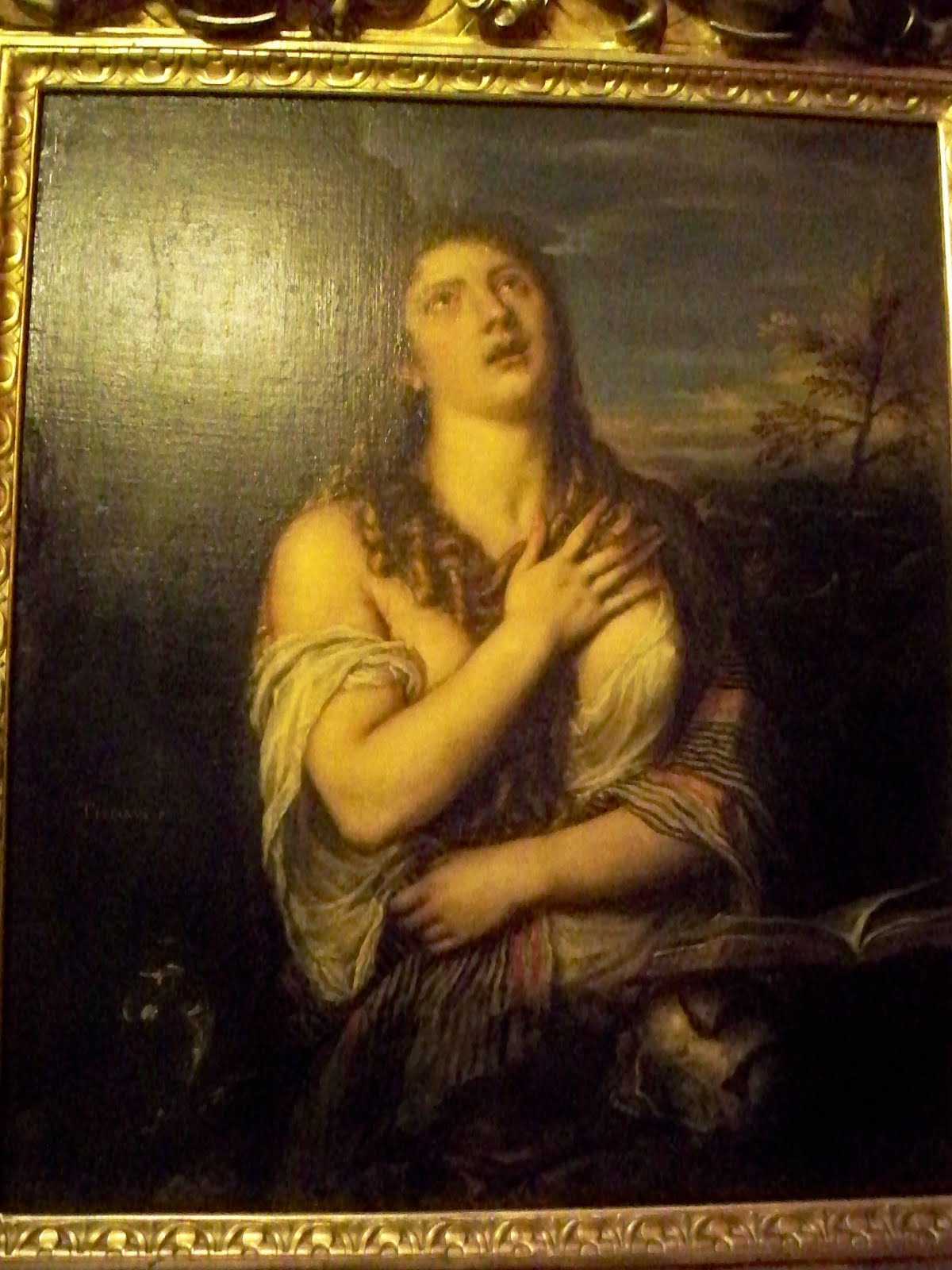
Or maybe it's an embarrassment of riches. I've uploaded a lot of pictures, in no particular order in regards to which ones are my favorite (I've have more to say about that later). Here I just wanted to give a sense of the amazing number of classics that are housed here at the Hermitage. I've developed a serious love of Spanish painting, which would definitely lead me to include this haunting representation of Mary Magdaline from Titian at the top - along with a typically riveting work by El Greco the third painting down. The second painting is from da Vinci, although the light coming in from the window - competing with the lights from the ceiling - didn't allow me to do it justice. The fourth painting is Caravaggio's Boy Playing a Lute, which really jumped out at me because Gombrich, in the book I'm using this semester for my Aesthetics class, makes a very big deal out of the painting - and I do like Caravaggio a lot. It's funny how you'll be using a picture in class and then when you actually see it hanging in a gallery it really hits you in an odd way. In a largely unsuccessful attempt to fight the lights and the glass plate covering it, I focused in pretty dramatically on Perseus, Andromeda and the image of Medusa on the shield in this painting by Rubens. There are lots of Rubens here at the Hermitage - and it got me thinking about the number of museums I've visited that also featured quite a lot of Rubens. I don't know how many pictures he painted, but it must have been an extraordinary amount because he's represented all over the place. Rembrandt is also well-represented at the Hermitage, and it was difficult to choose only one - however, I liked how Rembrandt put the holy family in a very domestic setting in this painting, which somehow brought about a greater divinity. There are quite a few Cezannes in the museum as well, and even though the paintings covered a number of topics, I always come back to his representation of fruit, especially pairs (although I feel like I'm just channelling Woody Allen in Manhattan). A typical exotic subject matter from Delacrois, but still an arresting image - I guess I just, probably romantically, imagine the rider heading into danger or into the wilderness. There were several Monets at the Hermitage, but I ended up liking the one that was in some ways the least Monet-like. There's just something about his representation of the woman in the white dress in the garden which moved me. There were several van Goghs as well, although I didn't find some of them (including some Gauguins) until late in the day in an entirely different section of the museum - and it was in an area marked no photography, which normally would have never stopped me, but I was also out of juice in the camera. I ended up choosing this particular painting from van Gogh, although, again by van Gogh standards, it was pretty "controlled." There were a number of Rodans, all of them good, so it was difficult to settle on this one. I liked this representation of Bacchus by Chagall. And, finally, I really like Renoir's Girl With a Fan - she's beautiful, certainly, but there's also a simple complexity - or complex simplicity (if that makes any sense) in her facila expression. I kept coming back to this painting. I could fill up this space with many more paintings - and have some more posts designed for Gauguin, etc. - but enough for now. I'm going to go outside and watch the drawbridges rise up!