Friday, September 16, 2016

My Year With Proust - Day 256

   The days that preceded my dinner with Mme de Stermaria, far from being delightful, were almost unbearable for me.  For as a general rule, the shorter the interval that separates us from our planned objective the longer it seems to us, because we apply to it a more minute scale of measurement, or simply because it occurs to us to measure it.  The Papacy, we are told, reckons by centuries, and indeed may perhaps not bother to reckon time at all, since its goal is in eternity.  Mine being no more than three days off, I counted by seconds, I gave myself up to those imaginings which are the adumbrations of caresses, of caresses which one itches to be able to make the woman herself reciprocate and complete - precisely those caresses, to the exclusion of all others.  And on the whole, if it is true that in general the difficulty of attaining the object of a desire enhances that desire (the difficulty, not the impossibility, for that suppresses it altogether), yet in the case of a desire that is purely physical, the certainty that it will be realised at a specific and fairly imminent point in time is not much more stirring than uncertainty; almost as much as anxious doubt, the absence of doubt makes intolerable the period of waiting for the pleasure that is bound to come, because it makes of that suspense an innumerably rehearsed accomplishment and by the frequency of our proleptic representations, divides time into sections as minute as any that could be carved by anguished uncertainty.
Marcel Proust, The Guermantes Way, pp. 397-398

Anticipation.  Marcel is waiting for his recently arranged dinner - and assignation - with Mme de Stermaria.  He's only waiting around three days, which, because it is shorter duration, and one therefore marked by a "more minute scale of measurement", as compared to the centuries or eternity that the Papacy marks time, it was an interminable wait.  And, as we all know, the wait only intensifies our desire.  Just as, to which we can once again all testify, "the difficulty of attaining the object of a desire enhances that desire. . ."  The anticipation of seeing and sleeping with Mme de Stermaria was already infringing upon his desire for Albertine while she was laying on his bed, which once again reminds us of how little of desire is actual physical; it's always about the conquest of the future or the conquest of memory or the conquest of perfection.

Note to self: use the words adumbrations and proleptic more in polite company.

Wednesday, September 14, 2016

My Year With Proust - Day 255

   On reaching the door, surprised that I had not preceded her, she offered me her cheek, feeling that there was no need now for any coarse physical desire to prompt us to kiss one another.  The brief relations in which we had just indulged being of the sort to which a profound intimacy and heartfelt choice sometimes lead.  Albertine had felt it incumbent upon her to improvise and add provisionally to the kisses which we had exchanged on my bed the sentiment of which those kisses would have been the symbol for a knight and his lady such as they might have been conceived by a Gothic minstrel.
   When she had left me, this young Picarde who might have been carved on his porch by the sculptor of Saint-Andre-des-Champs, Francoise brought me a letter which filled me with joy, for it waas from Mme de Stermaria, who accepted my invitation to dinner on Wednesday.  From Mme de Stermaria - that was to say, for me, not so much from the real Mme de Stermaria as from the one whom I had been thinking all day before Albertine's arrival.  It is the terrible deception of love that it begins by engaging us in play not with a woman of the external world but with a doll fashioned in our brain - the only woman moreover that we have always at our disposal the only one we shall ever possess - whom the arbitrary power of memory, almost as absolute as that of the imagination, may have made as different from the real woman as the Balbec of my dreams had been from the real Balbec; an artificial creation which by degrees, and to our own hurt, we shall force the real woman to assemble.
Marcel Proust, The Guermantes Way, p. 384

Once again, it is also perception and memory, or the perception of a memory: "It is the terrible deception of love that it begins by engaging us in play not with a woman of the external world but with a doll fashioned in our brain - the only woman moreover that we have always at our disposal the only one we shall ever possess - whom the arbitrary power of memory, almost as absolute as that of the imagination, may have made as different from the real woman as the Balbec of my dreams had been from the real Balbec. . ." It's strange how the human mind works.  Reading that line reminded me of the end of the great Tanizaki novel Some Prefer Nettles (long before I discovered Murakami I clearly had a fascination with modern Japanese fiction), which I haven't thought of in years, and how Misako's father would dress up his mistress O-Hisa as a doll.  We never actually possess the "woman of the external world," but maybe we never really wanted her in the first place.

My Year With Proust - Day 254

   In any case, whatever the modifications that had occurred recently in her life and that might perhaps have explained why it was that she now so readily accorded to my momentary and purely physical desire what at Balbec she had refused with horror to allow to my love, and even more surprising one manifested itself in Albertine that same evening as soon as her caresses had procured in me the satisfaction which she could not fail to notice and which, indeed, I had been afraid might provoke in her the instinctive movement of revulsion and offended modesty which Gilberte had made at a similar moment behind the laurel shrubbery in the Champs-Elysees.
   The exact opposite happened.  Already, when I had made her lie on my bed and I had begun to fondle her, Albertine had assumed an air which I did not remember in her, of docile good will, of an almost childish simplicity.  Obliterating every trace of customary preoccupations and pretensions, the moment preceding pleasure, similar in this respect to the moment that follows death, had restored to her rejuvenated features what seemed like the innocence of earliest childhood.  And no doubt everyone whose special talent is suddenly brought into play becomes modest, diligent and charming, especially if by this talent such persons know that they are giving us a great pleasure, are themselves made happy by it, and want us to enjoy it to the full.  But in this new expression in Albertine's face there was more than disinterestedness and professional conscientiousness and generosity, there was a sort of conventional and unexpected zeal; and it was further than to her own childhood, it was to the infancy of her race that she had reverted.  Very different from myself, who had looked for nothing more than a physical alleviation which I had finally secured, Albertine seemed to feel that it would indicate a certain coarseness on her part were she to think that this material pleasure could be unaccompanied by a moral sentiment or was to be regarded as terminating anything.  She, who had earlier been in so great a hurry, now, doubtless because she felt that kiss implied love and that love took precedence over all other duties, said when I reminded her of her dinner:
   "Oh, but that doesn't matter in the least.  I've got plenty of time."
Marcel Proust, The Guermantes Way, pp. 379-380

Things continue to get more intense as Marcel and Albertine canoodle on his bed.  Seldom has any author more gently described an erection.  ". . . her caresses had procured in me the satisfaction which she could not fail to notice and which, indeed, I had been afraid might provoke in her the instinctive movement of revulsion and offended modesty which Gilberte had made at a similar moment behind the laurel shrubbery in the Champs-Elysees..  In this case, however, as we read between the lines, clearly there is more than just an erection, as they "fondle" each other and Proust secures a "physical alleviation."  And, classically, and typically male, he then points out that it's late and doesn't she have someplace to be.  It's difficult to read the sentences, "Obliterating every trace of customary preoccupations and pretensions, the moment preceding pleasure, similar in this respect to the moment that follows death, had restored to her rejuvenated features what seemed like the innocence of earliest childhood," without thinking that he's achieved orgasm.  On the next page he continues, "She seemed embarrassed at the idea of getting up and going immediately after what had happened, embarrassed from a sense of propriety . . ."  It is a delicate description, and one that would have had to have been considered very adult a century ago.

What I find more interesting is Proust's dead-on comments about the meaning of a sexual act.  While he might have been talking specifically about his time with Albertine, I would suggest that it is true on a much more global scale.  "Very different from myself, who had looked for nothing more than a physical alleviation which I had finally secured, Albertine seemed to feel that it would indicate a certain coarseness on her part were she to think that this material pleasure could be unaccompanied by a moral sentiment or was to be regarded as terminating anything.  She, who had earlier been in so great a hurry, now, doubtless because she felt that kiss implied love . . ."  Essentially, he's making the point that whereas he would have viewed them having sex as the end of something (for instance, going back to an earlier discussion, of a military campaign) Albertine felt it was the beginning of something.  In the end, is that actually the difference between men and women?


Ace of the Staff

The last year or so has been a tough one for my great friend Gary Beatrice.  He started out, well over a quarter century ago, as a friend of a friend, but over the years has become one of my best friends.  He's a better husband and a better father and a better friend that I could ever hope to be, and he richly deserves all the wonderful things that life has to give and none of the bad ones.  In the face of a lot of pain and bad news he and his amazing wife Margie have been unflappable.  Things are looking great at the moment, and we're all thankful for that.  Last night, for I think the second time, he was chosen to throw out the first pitch at a Cincinnati Reds game.  I thought this was the coolest thing ever the first time he did it, and therefore I don't know what to say about a repeat performance.  I've always wanted to throw out the first pitch out a Reds game, but only if I could have my friend Dave Kelley at the plate - so I could dust him for crowding the plate.

Gary Beatrice and Dick Stewart.  Happily, they'll both be eligible for the Hall of Fame in the same year.

Beatrice bringing the heat, and making the fans forget Aroldis Chapman.

Gary being sexually accosted by Rosie the Red.

Tuesday, September 13, 2016

My Year With Proust - Day 253

   Apart from the most recent applications of photography - which huddle at the foot of a cathedral all the houses which so often, from close ot, appeared to us to reach almost to the height of the towers, drill and deploy like a regiment, in file, in extended order, in seeried masses, the same monuments, bring together the two columns on the Piazzetta which a moment ago were so far apart, thrust away the adjoining dome of the Salute, and in a pale and toneless background manage to include a whole immense horizon within the span of a bridge, in the embrasure of a window, among the leaves of a tree that stands in the foreground and is portrayed in a more vigorous tone, frame a single church successively in the arcades of all the others - I can think of nothing that can so great a degree as a kiss evoke out of what we believed to be a thing with one definite aspect, the hundred other things which is may equally well be, since each is related to a no less legitimate perspective.  In short, just as at Balbec Albertine had often appeared different to me, so now - as if, prodigiously accelerating the speed of the changes of perspective and changes of colouring which a person presents to us in the course of our various encounters, I had sought to contain them all in the space of a few seconds so as to reproduce experimentally the phenomenon which diversifies the individuality of a fellow-creature, and to draw out one from another, like a nest of boxes, all the possibilities that it contains - so now, during this brief journey of my lips towards her cheek, it was ten Albertines that I saw; this one girl being like a many-headed goddess, the head I had seen last, when I tried to approach it, gave way to another.  At least so long as I had not touched that head, I could still see it, and a faint perfume came to me from it.  But alas - for in this matter of kissing our nostrils and eyes are as ill-placed as our lips are ill-made - suddenly my eyes ceased to see, then my nose, crushed by the collision, no longer perceived any odour, and, without thereby gaining any clearer idea of the taste of the rose of my desire, I learned these obnoxious signs, that at last I was in the act of kissing Albertine's cheek.
Marcel Proust, The Guermantes Way, pp. 378-379

You can see why I would like to use some of Proust for my COR 110, Concepts of the Self, class, which all first year students take at Champlain College.  It is amazing how prescient Proust seems in regard to the full bloom of psychology and later rise of neuroscience.  However, I think that statement gives more credit to psychology and science than they deserve because it makes it seem that literature just hinted at things that, thank God, the harder and hard sciences revealed.  Rather, I think the opposite is true; the other fields were finally catching up to literature.  I always tell my students if they want to learn how to think they should read poetry, and I think I would definitely now include Proust (although the thought of making my students read all of Proust is somewhere between a pipe dream and an action that would inspire a lengthy prison sentence).  That would be the ultimate Trigger Warning: students, we're going to read Proust, so get ready for an unfamiliar tingling behind your eyes.  In this section Proust, as he finally prepares to kiss Albertine, struggles to see the "real" Albertine.   " . . . it was ten Albertines that I saw; this one girl being like a many-headed goddess, the head I had seen last, when I tried to approach it, gave way to another."  It reminds me of a student self-portrait from a few years ago, which I'm sure that I've mentioned, where a students photographed herself nude (probably not actually nude, but that is what she was trying to convey artistically) in front of a well-lit window.  The result was that she was in total dark silhouette, with the obvious message begin that even if you saw me nude, or I was with a lover in that ultimate moment, you would only see what I wanted you to see, and I still might be hiding everything.

Proust also reflects on the power and limitations of a kiss.  In an earlier passage, and resulting post, he talked about the limitations of the kiss, but here I think he is giving way to the power of a kiss.  " . . . I can think of nothing that can so great a degree as a kiss evoke out of what we believed to be a thing with one definite aspect, the hundred other things which is may equally well be, since each is related to a no less legitimate perspective."  Maybe a kiss is so limiting because it is so powerful and so overwhelming; it reduces us perception to that moment and that emotion, and thus it tells us less than watching a woman from across the street.

Sunday, September 11, 2016

My Year With Proust - Day 252

   I should have liked, before kissing her, to be able to breathe into her anew the mystery which had had for me on the beach before I knew her, to discover in her the place where she had lived earlier; in its stead at least, if I knew nothing of it, I could insinuate all the memories of our life at Balbec, the sound of the waves breaking beneath my window, the shouts of the children.  But when I let my eyes glide over the charming pink globe of her cheeks, the gently curving surfaces of which expired beneath the first foothills of her beautiful black hair which ran in undulating ridges, thrust out its escarpments, and moulded the hollows and ripples of its valleys, I could not help saying to myself" "Now at last, after failing at Balbec, I am going to discover the fragrance of the secret rose that blooms in Albertine's cheeks.  And, since, the cycle through which we are able to make things and people pass in the course of our existence are comparatively few, perhaps I shall be able to consider mine in a certain sense fulfilled when, having taken out of its distant frame the blossoming face that I had chosen from among all others, I shall have brought it onto this new plane, where I shall at last have knowledge of it through my lips." I told myself this because I believed that there was such a thing as knowledge acquired by the lips; I told myself that I was going to know the taste of this fleshly rose, because I had not stopped to think that man, a creature obviously less rudimentary than the sea-urchin or even the whale, nevertheless lacks a certain number of essential organs, and notably possesses none that will serve for kissing.  For this absent organ he substitutes his lips, and thereby arrives perhaps at a slightly more satisfying result than if he were reduced to caressing the beloved with a horny tusk.  But a pair of lips, designed to convey to the palate the taste of whatever whets his appetite, must be content, without understanding their mistake or admitting their disappointment, with roaming over the surface and with coming to a halt at the barrier of the impenetrable and irresistible cheek.  Moreover at that moment of actual contact with the flesh, the lips, even on the assumption that they might become more expert and better endowed, would doubtless be unable to enjoy any more fully the savour which nature prevents their ever actually grasping, for in that desolate zone in which they are unable to find their proper nourishment they are alone, the sense of sight, then that of smell, having long since deserted them.  At first, as my mouth began gradually to approach the cheeks which my eyes had recommended it to kiss, my eyes, in changing position, saw a different pair of cheeks; the neck, observed at closer ranged and as though through a magnifying glass, showed in its coarser grain a robustness which modified the character of the face.
Marcel Proust, The Guermantes Way, pp. 377-378

Things continue to get more and more serious, or at least more and more physical, between Marcel and Albertine.  Several things jump out at me in this passage, one of them being that despite Proust's usual sensitivity he unconsciously, or maybe quite consciously, portrayed the encounter as a military campaign.  He reflects on how "after failing at Balbec" he was going to discover more this time.  Even the description of Albertine's body reads like a map of desirable terrain: "But when I let my eyes glide over the charming pink globe of her cheeks, the gently curving surfaces of which expired beneath the first foothills of her beautiful black hair which ran in undulating ridges, thrust out its escarpments, and moulded the hollows and ripples of its valleys . . ."  So, for Marcel, like the rest of us, is sex just a matter of conquest?  A physical conquest?  Potentially; although I'm not that convinced that it is only sexual or physical.  Taken in the broader arc of their time together I think it relates to his reconquest of memory.  He tells us, "I should have liked, before kissing her, to be able to breathe into her anew the mystery which had had for me on the beach before I knew her, to discover in her the place where she had lived earlier; in its stead at least, if I knew nothing of it, I could insinuate all the memories of our life at Balbec, the sound of the waves breaking beneath my window, the shouts of the children."  Is this why we end up feeling so consumingly sad when we've slipped up and had sex with an ex; not because we've cheated on our present girlfriend, but because we've once again failed to recapture the past?

Proust's discussion of his lips, and their limitation, is also interesting.  Proust proposes, "For this absent organ he substitutes his lips, and thereby arrives perhaps at a slightly more satisfying result than if he were reduced to caressing the beloved with a horny tusk.  But a pair of lips, designed to convey to the palate the taste of whatever whets his appetite, must be content, without understanding their mistake or admitting their disappointment, with roaming over the surface and with coming to a halt at the barrier of the impenetrable and irresistible cheek." As I'm sure I've mentioned previously, the ancient Chinese philosophers grappled with the role of the sense organs because they are magnetically drawn to beauty - which is why Mencius proposed just being guided by the heart (mind). Proust tells us, ". . . my mouth began gradually to approach the cheeks which my eyes had recommended it to kiss . . ." As we know, the brain (and for that matter evolution) has its own agenda, and there logically, and thus illogically, must be a reason why the lips and the eyes are leading us in a certain direction.  But in following the demands of sensation - and the mad dance of evolutionary need - what else are we missing?

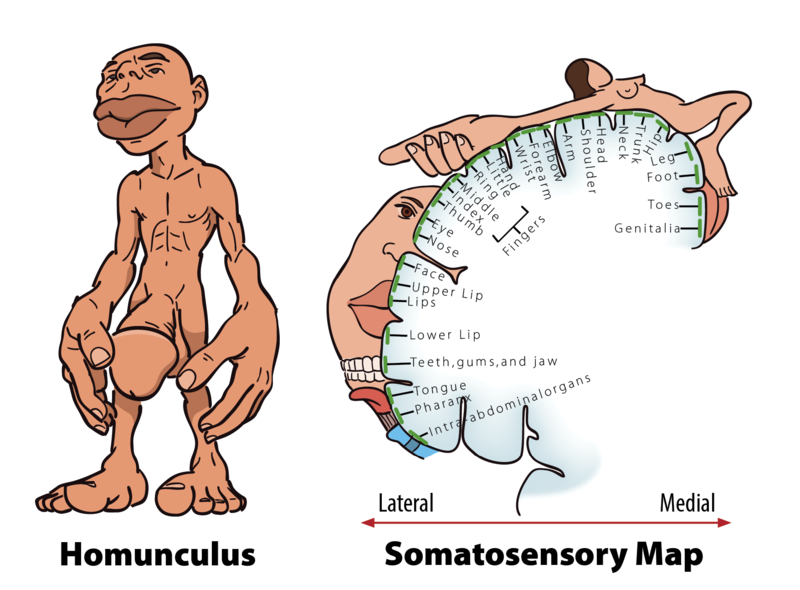
An diagram, complete with homunculus, showing the relative sensitivity of various sense organs, which, reflecting on the Proust passage above, represents the important role of the lips.  I've seen different versions of this homunculus, including one that appears in Linden's The Accidental Mind.  I borrowed this one from Adam John Privitera from Chemeketa Community College (http://nobaproject.com/modules/sensation-and-perception).

Saturday, September 10, 2016

Discography - Week 21

We've moved on to the twenty-first week of our weekly Discography discussion.  I like all the selections this week, and I suspect that more will sneak in before the weekend plays itself out.  This week we're featuring our first Trigger Warning, although I suspect not our last. Trigger Warnings are designed to warn a fellow Discography member (could be anyone, really) not to read further because it would be an affront to everything they hold dear musically. This is not the same as the person mentioned being labelled a Walking Trigger Warning (although she is, although this could be anyone).  That would be a good theme week: Trigger Warning Songs for a specific Discography member (could be anyone).


Nate Bell

I'm pretty excited about this pick, and I hope I can convince the group to listen to this whole album, just so we can discuss it.

Kentucky Knife Fight, Bad Blood and Father from Hush, Hush

About 5-6 years ago, M and I were attending the local Midpoint Music Festival, and stumbled across this band.  At the time, they were in one of the worst venues, in a decent bar, but with the band set up in a server's station next to a stairwell.  We immediately latched onto their incredibly diverse and unique sound.  There was a starveling bald lead singer, strong guitar and bass, and harmonica and banjo.  Their sound eludes categorization, but the closest I can come is "post-punk noir rock".

The sound was insistent and harsh...the singers voice is at once reedy, buzzing and a growl, unlike almost anything else I had heard.  We rushed to buy a CD.

The band is Kentucky Knife Fight, and despite the name, they are not alt-country, no one is from Kentucky, and there is no mention of knife fighting or even a knife that I can recall in any of their albums.  This band has since broken up, but they are from St. Louis, and had a very strong following there.  M and I traveled to see them a handful of times after that first concert, and ended up spending a fair amount of time talking to the various band members about politics, the state of education in America, disabilities, urbanization, crime, racism, and literature.  And they play some great music.

The front man, a wasted and tortured soul, was clearly the inspirational force behind the band, and it is clear that he is, at heart, a writer with a music problem.  The selections I have for you this week come from Hush Hush.  This album is a "concept album", but I feel it goes beyond that often-worn description, and it is actually a well-crafted short story with music.  The album tells a tale of a awful and sordid crime, a diamond heist gone terribly wrong, told from the varying points of view of the couple enlisted to commit the crime, and their sociopathic, petty mastermind of a "recruiter".  It is told also in flashbacks, backstory, and retrospective, all glimpses of characters and history that is fascinating--facets, if you will of an entire whole.  The band describes the album as :  A seductive collection of songs about crime and human sexuality, which attempts to understand why good people do bad things.

I was very compelled by the vocal style, but others may be immediately put off by it.  I would encourage you to power through the vocal style if you do not enjoy it, and listen to the lyrics and phrasing, and I think you will be intrigued by the storyline.  

"Bad Blood"--this song is energetic, pounding, and chaotic.  It's told from the point of view of one of the newly recruited criminals, and it captures very well an emotive sense of the greasy, amphetamine driven rush of the criminal's excitement at the prospect of the caper, and the lyrics hint at the harsh resolution that is to come.  You can clearly see the dodgy interior of the Tic Toc Inn and the sketchy, twitchy motions of the newly recruited thug.

This piece is told from the point of view of the Recruiter, who is simultaneous recruiting one of the people who will commit the deed, while at the same time reminiscing in glee about a major crime the Recruiter committed with the subject's father in the distant past.  The old and storied crime appears to be the sort of chaos and destruction done without any apparent purpose other than to sow strife.  It is told musically in a languid, tingling, but sinister form, building to a crescendo that reveals the deep seated psychopathy of the Recruiter---showing the listener where the current plot will lead, to the destruction of the flawed and tainted ne'er do wells who will carry out the heist and murder.  Even in the memory of the Recruiter, the past Grand Crime resulted in a nearly deadly confrontation which the Recruiter appears to recall with great fondness and pride, which in itself is enough to cause a small shiver in the spine of the listener.  (the youtube video is not, unfortunately, as good as the album version or the live versions we heard, but was the best one I could find)  Here are the lyrics, from their still operative website.


I truly encourage the group to listen to the whole album as a whole story.  We will gladly share the album, so that we can all discuss the "story" contained in it.  I hope you find it as darkly interesting as we do.


Miranda Tavares


Cake has a unique sound, but it is a specific sound, sometimes stopping just short of formulaic, and this song is no exception. So why pick it? Well, the timing is pretty cool, even by Cake standards. And the patented Cake awkwardness is minimized, which I prefer (except in Sad Songs and Waltzes, which is kind of the point of the song). But mostly, this is a man singing about wanting a strong woman. It is a song about a woman who is a force to be reckoned with. This chick is freaking amazing. She is a worthy role model for all women. Fellow females (of which there is exactly one on this blog - Gary B., can you PLEASE convince Marjie to join in now and then) let's don our short skirts and long jackets and forego the sexist pantyhose. I will aim for having a mind like a diamond; I have always wanted to be fast, and thorough, and sharp as a tack; I would love to wield a machete to cut through red tape; and who doesn't want fingernails that shine like justice?! But...this song is a dude's list about his requirements. It is a shopping list for a woman. Essentially, he is creating his own version of a Stepford wife...who just happens to be powerful instead of yielding. Does the latter cancel out the former? Does it make it all politically correct? I am not entirely sure. But I do know that, right or wrong, I still want to be that girl. 


Dave Wallace

Tommy James and the Shondells, Mony Mony


Party Time!!  One of the all-time great rock songs, with the catchy keyboard riff, the brilliant call-and-response, the delirious "Mony Mony" chant, and the fantastic break.  Then, just when you think it can't go any higher, the song finds another gear towards the end, with James yelling "Come ON!" repeatedly.  Irresistible!


Gary Beatrice

Wilco, At Least That’s What You Said

Cyndi and I have something in common. I am a Wilco boy. And I've got it bad.

I may have lost some alt.country cred last week when I argued that the Bottle Rockets are at least as good as Uncle Tupelo. Well Gary may kick me off the blog today.

Jeff Tweedy and Wilco have far exceeded the music of Sun Volt and Jay Farrer in his numerous post Uncle Tupelo incarnations. And, in fact, alt.country or not, Wilco's music is better than Uncle Tupelo's. Maybe not more important, certainly not more influential. But better.

I've read the lyrics to At Least That's What You Said, and the best I can tell they don't mean a thing. And that is fine by me. This is all about a great band stretching out and sounding outstanding. Like Cyndi, this is one of many Wilco songs that never fails to put me in a good mood.


Dave Kelley

Here comes the inevitable overwrought DK post about Bruce Springsteen.  Once again, I am going to cheat a bit and include two songs.  I think this is legitimate though because the songs are linked, and the second one even references the first.  To me they represent the yin and yang of The Boss.

The first is Thunder Road.  Need I even say much about this classic?  Any song that begins "The screen door slams, Mary's dress waives, like a vision she dances across the porch as the radio plays", includes such great singing and piano work, and concludes with:

"There were ghosts in the eyes of all the boys you sent away.  They haunt this dusty beach road in the skeleton frames of burned out Chevrolets.  They scream your name at night in the streets, your graduation gown lies in rags at their feet.  And in the lonely cool before dawn, you hear their engines roaring on.  But when you get to the porch they're gone, On the wind.  So Mary climb in.  It's a town full of losers, and I am pulling out of here to win." is a classic.  To my ear, it is the most perfect song of the rock era.  I would not change a damn thing.

Bruce wrote this in his early twenties.  That is a time in many of our lives when we are Romantics in every sense of the term.  The perfect night with the right girl, the right car, and the right opportunity makes everything possible.  All things are within our grasp.  Bruce has described the a great pop single as the eternal now.  I think "Thunder Road" captures that feeling   I think the spirit that infuses "Thunder Road" should still grab us occasionally no matter our age.

But life is not that simple.  Life is messier than art.  The perfect night with the perfect girl ends, and the new day must be faced.  Most of our dreams are not totally fullfilled.  Fuck, most of them are not fulfilled at all.  A young person's dreams become an adult's regrets more often than not.  "Is a dream a lie if it don't come true, or is it something worse."  Life is not art.  It is not perfection.  It is more often than not a series of compromises and disappointments.  I think a huge part of adulthood is dealing with these hard realities without waving a white flag. 

After the great success of the Born to Run record and tour, Bruce realized that he had signed an awful deal with his producer.  To make matters worse, his producer was a dear friend and someone that Bruce felt he could trust.  Mike Appel not only owned Bruce's music, he controlled his future releases and was able to get an injunction which prevented Springsteen from recording with anyone else.  For several years, Bruce could not release new music and had to support himself and the band by playing live.  His cover of "It's My Life" in his live shows  of that period reflect his feelings and his anger.  Eventually he regained control of his music and his future by signing a big check.  This left him deeply in debt but back in control.  He said that more than money, more than fame, and even more than happiness, he wanted to be great.

I think "Darkness on the Edge of Town" is perhaps Bruce's greatest record.  It is very much informed by the betrayal he felt from a dear friend.  Bruce gave many great songs that he wrote at the time away to other artists because he felt that they did not fit with the "apocolyptic grandeur" that he was seeking.  "Fire" and "Because the Night" are two of the songs he gave to others.  However, there was another song left off of the record that he did not give away.  To my mind, it is one of the five or ten best song he has ever written.  It would have fit perfectly on Darkness but perhaps it hit too close to home.  That song is "The Promise", and it is my second selection for the week.

The singer in "The Promise" is not a musician but is instead a guy who built a race car.  A Challenger.  The song is about betrayal and cashing in on a dream. The romanticism of "Thunder Road" has been replaced with the realism and hard realities of adulthood.

"Well I built that Challenger by myself
But I needed money
and so I sold it
I lived a secret I should have kept to myself
but I got drunk one night and I told it.

All my life I fought that fight
that fight no man can ever win
every day it just gets harder to live
that dream you're believing in"

Later he sings:

"When the promise is broken
you go on living
but it steals something from down in your soul
Like when the truth is spoken
but it don't make no difference
and something in your heart goes cold."

At several points in the song, the singer plaintively repeats the line "Thunder Road" making the connection between the two songs clear. 

"Thunder Road is for the lost lovers and all the fixed games
Thunder Road is for the tires rushing by in the rain
Thunder Road, me and Billy we'd always sing
Thunder Road, we'd take it all and throw it all away."


For me, The Promise is about holding onto your ideals after you have lost your idealism.  It is about living a life filled with compromises and disappointments and yet not giving up.  You and Mary may may have pulled out of there to win, but hard reality ultimtely sets in and what the fuck are you going to do about that.   A much more recent Bruce song talks about "Hold tight to your anger, but don't fall to your fears."   I have a hard time listening to "The Promise" without getting teary eyed. 


Gary Scudder

* * * MIRANDA TRIGGER WARNING * * *

Frank Sinatra, If You Are But a Dream

I had a couple different songs that I was considering this week, but in the end I just followed my usual dictate of just writing up what I'm listening to that week.  Recently I downloaded the Essential Frank Sinatra from the Columbia Years (which I owned as a CD in a different lifetime).  Yes, I admit it, I love Frank Sinatra.  The most excellent Gary Beatrice and I have had a long-running, although friendly, debate on which Sinatra is better: the Big Band Frank from the 1940s or the Cool Frank from the 1950s and early 1960s?  They are both noble options, but I tend to come down on the side of Big Band Frank.  To me this is just about a perfect song.   It also provided the soundtrack for one of the great movie scenes of all-time: Woody Allen reflecting upon his first visit to Radio City Music Hall from the sadly underappreciated film, Radio Days.